

Let's be real. Picking event software is a total drag.
You’re pouring your heart into a workshop, a pop-up dinner, or a local show. The last thing you need is a ticketing platform skimming your profits or slapping its ugly branding all over your page.
The best ticketing platform for events is the one that gets out of your way. It lets you control your brand and pays you quickly. Simple as that.
You Just Want to Sell Tickets, Minus the Drama

This guide is for people who just want to sell tickets, look good doing it, and get paid without needing a degree in finance. We’re skipping the corporate jargon and getting straight to what actually matters for small events.
We’ll talk setup time, branding control, fees, and how fast your money hits the bank.
The goal isn't to find some magical one-size-fits-all platform. It’s to find the right tool for your event, whether you're expecting ten people or a thousand.
What Actually Matters When You're Selling Tickets
Forget the endless feature lists for a second. Your choice really comes down to a few key things that directly impact your sanity and your wallet.
Let's focus on the practical stuff.
Fast Setup: Can you get your event page live in minutes without writing code or calling support?
Branding Control: Does your event page look like your brand, or a giant ad for the ticketing company?
Simple Fees: Is it a clear, flat fee, or are you losing a percentage of every ticket to hidden charges?
Quick Payouts: Does your money land in your account right away, or is it held hostage for weeks?
The online event ticketing market is booming. It's set to jump from $53.43 billion in 2025 to $69.25 billion by 2029. Mobile ticket buying already makes up 58.95% of all online sales. A mobile-friendly platform isn't just nice to have; it's essential. You can read the full research on ticketing market growth if you want the details.
You need a tool built for real people, not massive corporations.
The Five Questions That Simplify Your Choice
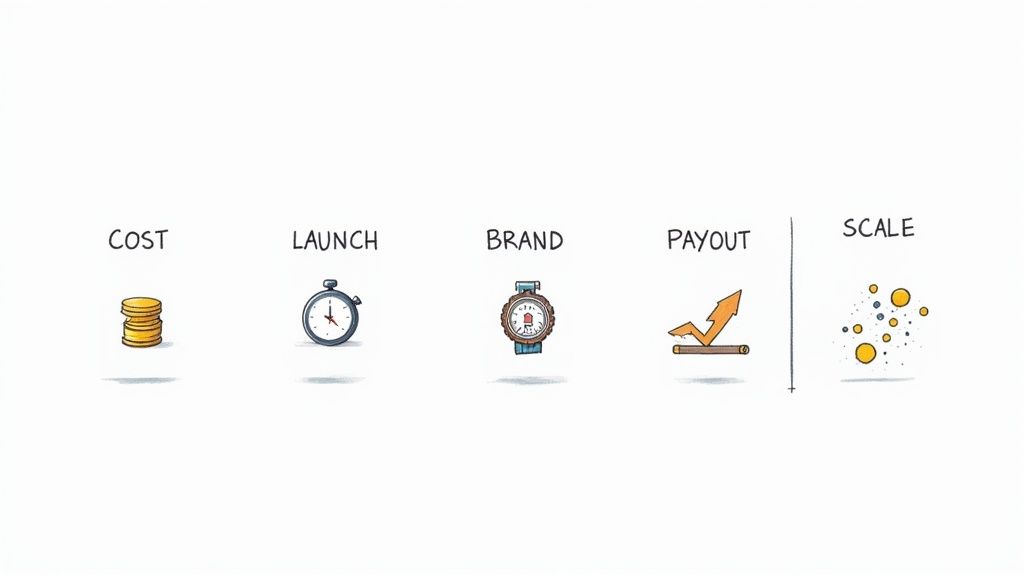
Before you fall down a rabbit hole of feature comparisons, let's cut to the chase. Choosing the right ticketing platform isn't about finding the one with the most buttons. It's about answering five straightforward questions.
Nail these, and your decision gets 90% easier. You don't need a spreadsheet with a hundred rows. You just need clarity.
1. What's the Real Cost?
The price you see is almost never the price you pay.
A platform might advertise as "free," but then quietly skim a percentage off every ticket. Others hit you with a per-ticket fee plus a payment processing fee. It adds up, fast.
So, ask what you'll actually pay. Is it a predictable flat fee or a confusing mess of percentages? On a $50 ticket, a 5% fee costs you $2.50. Sell 100 tickets, and that’s $250 gone.
A flat fee is honest. You know exactly what you’re paying. Budgeting becomes a whole lot easier.
2. How Fast Can I Launch?
Your time is your most valuable asset. You're a creator, not a web developer.
Some platforms make you wrestle with complex settings just to get a basic page live. It’s an absolute time sink.
The real question is: Can I set up and sell my first ticket in the next ten minutes? A good platform should be intuitive. You should be able to create a professional-looking event page with zero code and launch it before your coffee gets cold.
If the setup feels like a chore, it’s the wrong tool.
3. Whose Brand Is on the Ticket?
When someone buys a ticket, they should be excited about your event, not the ticketing company.
But many platforms plaster their logo all over your page and emails. This can make your event feel less professional and dilutes your brand.
Look for a platform that offers custom branding. This means you can use your own logo, colors, and fonts. The ticketing page should feel like a seamless part of your own website.
It’s your event. It should look like it.
4. How Quickly Do I Get Paid?
For small organizers, cash flow is everything. You have venues to book and supplies to buy. Waiting weeks after your event to get paid is a dealbreaker.
Unfortunately, many platforms hold your funds for five or more business days after the event ends.
This one’s simple: how fast does the money hit your account? You want a platform that offers fast, secure payouts straight to you. When a ticket sells, that money should be yours, not sitting in some corporate holding account.
5. Can This Grow With Me?
You might host a five-person workshop today. What about a 500-person conference next year? The best ticketing platform should handle both without a fuss.
You need a tool that works just as well for an intimate gathering as it does for a large festival. It should feel effortless whether you’re selling to five people or five thousand.
The platform shouldn't limit your ambition.
The Three Kinds of Ticketing Platforms
Alright, let's get real. The ticketing world is split into two camps: the giants who own the stadium scene and the indie players built for creators like you.
This isn't just another pros and cons list. We’re digging into where each type of platform makes sense and where it completely misses the mark.
Think of it like picking a vehicle. You wouldn't take a semi-truck to the grocery store. You wouldn't move your apartment with a scooter. It’s about matching the tool to the job.
The Big Guys Like Ticketmaster
When you think of a massive arena concert or a pro sports game, Ticketmaster probably comes to mind. They are the champs of huge, high-volume events.
Their power comes from exclusive contracts with stadiums. If you want to sell out a 20,000-seat venue, you’re probably going through them.
For an independent creator, though, this model is a non-starter. The system is brutally complex. The fees are legendary for a reason. It’s all built for corporate-level events, not your 50-person workshop.
Ticketmaster holds a staggering 63% share of the U.S. online ticket buyer market. If you want to dive deeper, you can discover more insights on the online ticket sales industry.
The All-Rounder Like Eventbrite
Most of us have used Eventbrite at some point. It’s the Swiss Army knife for everything from local festivals to professional conferences.
Their biggest draw is discoverability. Listing your public event on their platform means you can tap into their audience. This is a huge win for community-focused gatherings.
But that convenience comes with trade-offs. Their fees are percentage-based, meaning they shave a slice off every ticket. Your branding is also stuck in their world. Your event page will always look like an Eventbrite page. Payouts can also be a waiting game.
The Creator's Choice: Indie Platforms
This is where things get interesting for small to mid-sized event hosts. A new wave of independent platforms has emerged, built from the ground up for creators.
They ditch the complexity. They focus on what truly matters: getting you set up fast, giving you brand control, and offering pricing that doesn’t feel like a penalty.
Instead of a percentage cut, many use a simple, flat fee per ticket. This makes your costs predictable. You can spin up an event page in minutes, no code needed. Most importantly, they offer real white-label branding, so your ticketing page looks like a natural part of your website.
They’re designed for the pop-up chef selling 30 seats or the instructor launching a weekend workshop. The focus is on empowering the creator with tools that are simple and stay out of the way. If Eventbrite feels too generic, it's worth exploring these excellent websites similar to Eventbrite that put creators first.
Ticketing Platform Head-to-Head Comparison
Here’s a no-fluff breakdown of how these platforms stack up on the features that actually matter.
| Feature | The Big Guys (e.g., Ticketmaster) | The All-Rounder (e.g., Eventbrite) | The Creator's Choice (e.g., Ticketsmith) |
|---|---|---|---|
| Real Cost | Very high percentage fees plus facility charges. | Percentage fee + per-ticket fee (e.g., 3.7% + $1.79). | Simple, flat fee per ticket. No surprises. |
| Launch Speed | Slow. Requires contracts and dedicated reps. | Relatively fast, but can be cluttered with options. | Setup in minutes. No code or complexity. |
| Branding | Venue-focused branding. Minimal control for you. | Limited. Your page is heavily Eventbrite-branded. | Fully customizable to match your own brand. |
| Payouts | Complex and slow, tied to venue agreements. | Slow. Typically holds funds until after the event. | Fast and secure. Payouts go straight to you. |
| Best For | Stadium tours, pro sports, and massive festivals. | Community festivals, free events, and public gatherings. | Branded workshops, pop-ups, courses, and indie events. |
The "best" choice is completely situational. If you’re Taylor Swift, you need Ticketmaster. If you’re organizing a free neighborhood cleanup, Eventbrite is a great fit. But if you're a creator building a unique, branded experience, an indie platform is almost always the smarter move.
Which Platform Fits Your Real-World Event?

Theory is one thing. Your event isn't a theory. It's a real thing you're pouring your heart, time, and money into.
Let's get practical and walk through a few common scenarios. You’ll probably see a bit of your own event in these stories.
For The Pop-Up Chef With A Cult Following
Meet Alex, a pop-up chef who hosts a 30-person dinner series once a month. Her reputation is built on attention to detail, from the ingredients to the font on the menu.
Alex needs a ticketing platform that reflects her brand. A generic page plastered with someone else’s logo just won’t cut it. It would instantly cheapen the experience.
She also needs dead-simple pricing. With tight food costs, a platform skimming 3% to 5% off each ticket would crush her margins. For Alex, the best platform has:
Custom Branding: The ticket page has to look like her brand. No compromises.
Flat-Fee Pricing: Predictable costs are non-negotiable.
Fast Setup: She has to spin up a new event page in minutes each month.
A creator-focused platform with white-labeling and flat fees is the only logical choice. It gives her the brand control of a custom-built site without the headache.
For The Creative Pro Running Online Workshops
Now consider Maya, a designer who teaches a popular online lettering workshop for about 20 attendees.
Her priorities are efficiency and professionalism. She needs a clean, reliable system that’s easy to repeat.
Her attendees are paying for her expertise. The entire process needs to feel polished. A messy, ad-filled checkout page would undermine her credibility. She needs a platform that offers:
A simple, clean interface that’s free of clutter.
An easy way to duplicate past events to launch a new workshop in seconds.
Fast, secure payouts so she isn't left waiting on her earnings.
Maya’s best bet is a platform that prioritizes a minimalist user experience and quick setup. It gets out of her way so she can focus on her curriculum.
For The Local Band Booking Their Own Show
Finally, there's a local band that booked their first headlining show at a 200-person venue. They handle their own promotion and need a ticketing system their fans trust.
Their audience lives on their phones. A clunky mobile checkout is a recipe for lost sales. They also need access to their ticket revenue now to pay the venue deposit.
For them, the right ticketing platform provides:
Mobile-First Design: The buying process must be flawless on a smartphone.
Fast Payouts: They need access to funds as they come in, not weeks after the show.
Reliability: The system has to work perfectly for scanning tickets at the door.
An indie platform built for real-world use is perfect. It gives them the speed and financial flexibility they need. For larger events, they might also need things like effective wayfinding signage.
Each of these creators found a tool that fit their specific job. The chef needed brand control, the designer needed efficiency, and the band needed cash flow. Your event has its own needs. Find the platform that serves them.
The Hidden Costs Of 'Free' Ticketing Platforms

You know the old saying: if you’re not paying for the product, you are the product. Many event organizers learn this the hard way with "free" ticketing platforms.
That big, friendly "free" sign is just the tip of the iceberg.
The real price is usually buried in the fine print and passed on to your attendees. What looks like a freebie to you ends up as a nasty surprise for them at checkout.
The Most Common Traps
The most obvious catch is the percentage-based fee. A platform might not charge you upfront, but it'll happily skim 3%, 5%, or more off every ticket. On a $100 ticket, that’s $5 gone. Sell 200 tickets, and you've just handed over $1,000.
Then you’ve got the branding problem. "Free" platforms often turn your event page into a giant billboard for their business. Your logo gets tucked into a corner while theirs takes center stage.
And finally, there's the time tax. A confusing, clunky setup that takes hours isn't free. Your time is valuable. A platform you can get up and running in minutes, with no code required, saves you a resource you can never get back. We pulled together some great tools in our guide to free event planning software that respect your time.
Holding Your Money Hostage
One of the sneakiest hidden costs is the payout delay. You did the work, sold the tickets, and pulled off a great event. So... where's the money?
It's shocking how many platforms will hold your funds for days or even weeks after the event is over.
This can be a nightmare for smaller organizers who need that cash to pay vendors. A good platform should offer fast, secure payouts that go straight to your account. It's your money. You shouldn't have to wait for it.
Who Really Owns Your Attendee Data?
Here’s a big one: data ownership. When someone buys a ticket through certain platforms, their contact info often gets vacuumed into the platform’s marketing database. Soon, your attendees are getting emails about other events.
You lose that direct line to your audience. This is a major point of difference between platforms. For instance, Eventbrite is known for helping creators sell directly and build fan relationships. With 74.5% of planners expected to adopt a hybrid format in 2025, that direct connection is gold. You can learn more about ticketing platform trends here.
The best ticketing platform for your events understands that your attendees are yours. Look for services with transparent, flat-fee pricing that put you in control of your brand, your money, and your customer data.
How To Pick Your Platform And Sell Your First Ticket
Alright, it’s decision time. You’ve waded through the options and squinted at the fee structures. The best ticketing platform is the one that gets out of your way.
It should feel like a helpful partner, not a confusing gatekeeper. Your energy belongs in creating an amazing experience, not decoding software.
A Simple Final Checklist
To cut through the noise, let's make this simple. Run your top choice through this final, no-fluff checklist.
Predictable Fees: Is it a clear, flat fee? Or will a percentage of every sale vanish?
Your Branding, Not Theirs: Can you make the page look like yours with custom branding?
Speedy Setup: Can you go from idea to live ticket sales in minutes with no code needed?
Handles Any Crowd: Does it work for a five-person workshop and a five-hundred-person festival?
If your choice passes this test, you've likely found a winner. The final step is the most important one: Just do it.
Launch Your Event Today
Seriously, that’s it. Sign up, create your event page, and sell that first ticket. The right tool makes this part exciting, not scary.
It handles the boring stuff—payments, check-ins, all of it—so you can focus on what you love. For more tips, our guide to online ticketing for events has some great tactical advice.
Of course, once you’ve picked your platform, you still need to get the word out. For a look at effective event marketing strategies, you might find this resource helpful.
The goal is to get your event out into the world. A good platform makes that happen with fast, secure payouts and a system built for real people. Now go sell that first ticket. You've got this.
Still Have Questions? Let's Clear a Few Things Up.
Event organizers tend to bump into the same questions. Here are some straight answers.
What's the Single Most Important Feature to Look For?
Honestly, it’s simplicity and transparency. The best platform gets out of your way so you can get back to planning.
If you have to wrestle with the setup or decipher a confusing pricing table, you're using the wrong tool. Your time and sanity are worth more than features you'll never touch. The goal is a dead-simple, no-code setup paired with flat-fee pricing.
Is Custom Branding Really That Important?
Yes, absolutely. Your ticketing page is often the first real interaction someone has with your event. When that page is plastered with another company's logo, it cheapens your brand.
Custom branding signals that your event is legitimate. It builds trust from the first click and creates a seamless experience.
Your event is a reflection of your hard work. Don't let a ticketing platform's logo overshadow it.
How Much Should I Actually Expect to Pay in Fees?
Fees are all over the map. You should run from anything that feels like a mystery. Avoid any platform that wants to skim a percentage of your revenue.
A 5% fee on a $100 ticket costs you $5. For 200 tickets, that’s $1,000 gone.
A fair platform is upfront about its costs, usually charging a simple, predictable flat fee per ticket. That way, you know exactly what you're paying. More of the money you earn stays with you.
How Fast Will I Get My Money?
You should get paid, well, fast. Some platforms hold your funds until days or weeks after the event is over. This can create a massive cash flow headache.
Look for a service that provides fast, secure payouts directly to your account as you sell tickets. It’s your money, after all. You earned it. There's no reason you should have to wait.