
Ever feel weird sending your audience to a big, clunky ticketing site? It’s like hosting a pop-up dinner but making guests line up outside a different restaurant first.
A white label ticketing platform fixes that. It lets you sell tickets for your event directly from your own website, under your own brand.
You get all the professional tools, but your name is on the door. It’s that simple.
So, What's It Actually Doing?
When you use a big ticketing site, you’re on their turf. Their logo is everywhere. They show your attendees ads for other events. They skim a percentage off your sales and add "service fees" that annoy your customers.
A white label ticketing platform flips that entirely. It’s tech that works in the background, handling the messy parts of selling tickets while your brand gets all the credit.
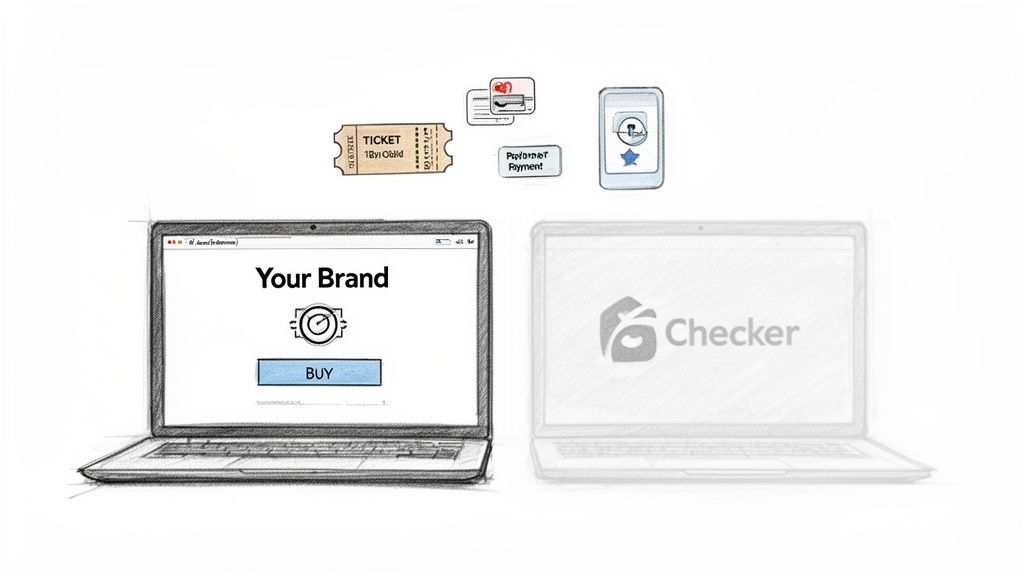
You get a smooth, professional experience. This builds trust the moment someone decides to buy. No jarring redirects to another site. No confusing third-party logos. Just your event, your colors, and your brand.
Who Is This For?
It’s for anyone pouring their heart into an event. The yoga instructor running a weekend retreat. The chef hosting an intimate supper club. The local organizer putting together a community market.
It's built for real people who care about the details.
The goal is to give you tools that make you look like a pro, without needing a computer science degree. You can get set up in minutes, no code needed. The whole thing feels like a natural part of your website.
The core idea is simple: You should own your event experience from start to finish. That includes the ticket purchase. A white label platform makes that possible.
White Label vs. Big Ticketing Sites
How does this really stack up against the household names? One approach builds their brand. The other builds yours.
Here’s a quick comparison.
| Feature | White Label Platform | Traditional Ticketing Site |
|---|---|---|
| Branding | Your logo, your colors, your domain. It looks like you. | Their logo, their colors, their domain. You're just a listing. |
| Customer Experience | Seamless. Attendees stay on your site, which builds trust. | Clunky. Customers are sent to an unfamiliar third-party website. |
| Pricing Model | A simple, flat fee per ticket. Honest and predictable. | A percentage of each sale, plus extra fees for your buyers. |
| Attendee Data | You own it. You build your email list and community. | They own it. They market other events to your attendees. |
| Payouts | Fast and direct to your account. Often as tickets sell. | Often delayed until after your event. |
Whether you’re selling five tickets for a small workshop or five thousand for a local festival, the principle is the same. A white label ticketing platform gives you control, professionalism, and a bigger piece of the pie.
Keep Your Brand Front and Center
When someone decides to buy a ticket, their experience with you has already started. Why would you want their first impression to be with another company’s brand?
This is where a white label ticketing platform completely changes the game. It ensures every single touchpoint—the checkout page, the confirmation email, the ticket itself—is wrapped in your logo and your colors.
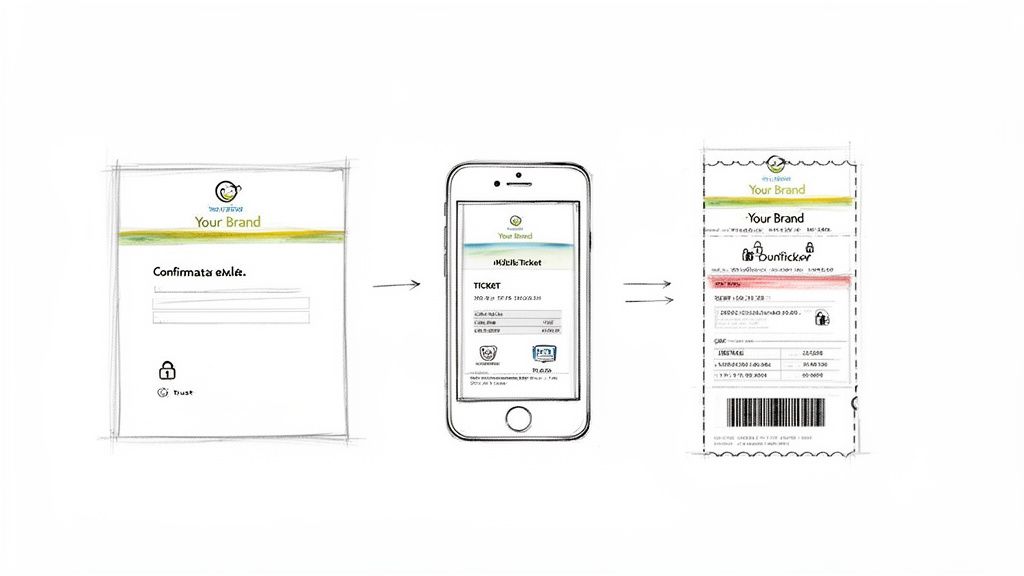
This isn't just about looking good. A seamless, branded checkout process builds immediate trust. It makes your whole operation feel more professional, whether you’re selling five tickets or five thousand.
Own Your Audience, Own Your Data
When you use the ticketing giants, you’re basically renting their audience and handing over your own. They get the customer data. They get to market other events to your people.
A white label solution puts that direct connection back in your hands.
Here’s what that actually means for you:
You build your email list directly. Every ticket buyer is a potential repeat customer you can talk to.
You get clean, undiluted data. Understand who your attendees are, without a third party's noise in the way.
No distracting upsells. Your confirmation page won’t advertise a competing concert across town.
This level of control is a huge deal, especially for smaller organizers. It’s the difference between building a loyal community and just processing a one-time transaction. A full market analysis shows this trend is growing fast as creators demand platforms they can truly make their own.
Beyond the Ticket
A consistent brand experience doesn’t just stop with the digital ticket. It creates a cohesive feeling that carries through the entire event.
This same principle applies everywhere. Just as a white label platform puts your brand on the ticket, using branded merchandise for business can amplify that feeling and give your fans something tangible to remember you by.
The bottom line is this: You’re pouring your heart into your event. Your ticketing should reflect that effort, not dilute it with someone else's brand.
By keeping the focus on your brand, you create a stronger, more memorable experience that encourages people to come back again and again.
Understanding Fair and Simple Pricing
Let's talk about the money. Specifically, where it goes after someone buys a ticket.
Most ticketing platforms have a complicated relationship with your revenue. They skim a percentage off every ticket, then often add a sneaky "service fee" for your attendees. It's confusing, frustrating, and quietly eats into your profits.
This model forces you into a guessing game. It feels like you’re being punished for selling more tickets.
The Problem with Percentage Fees
Imagine you're hosting a fifty-person workshop at $100 per ticket. A platform that takes a 5% cut plus a $1.50 fee per ticket doesn't sound too bad at first.
But let's do the math.
Gross Revenue: 50 tickets x $100 = $5,000
Platform's Cut: (5% of $5,000) + (50 x $1.50) = $250 + $75 = $325
Suddenly, you’re out $325. That’s real money you could be using for better lighting, paying a collaborator, or just… keeping.
This is why a white-label ticketing platform often opts for a saner approach.
A predictable, flat fee changes everything. Instead of wondering how much you'll lose, you know exactly what your costs are from the start.
A Refreshingly Simple Alternative
The alternative is wonderfully boring: a flat fee. You pay a simple, fixed amount per ticket sold. That’s it. No percentages. No hidden charges.
Let’s go back to that fifty-person workshop, but with a simple $1 flat fee per ticket.
Gross Revenue: $5,000
Platform's Cut: 50 tickets x $1 = $50
You Keep: $4,950 (instead of $4,675)
You just kept an extra $275. This straightforward pricing puts you in control. Plus, with fast, direct payouts through partners like Stripe, the cash goes straight to your account. You aren't left waiting weeks after your event to get paid.
When you're managing a budget, that kind of clarity is everything. For more on managing event finances, you might find our thoughts on free event planning software helpful.
The Right Features for Your Event
Not all white-label ticketing platforms are built the same. It’s easy to get lost in marketing fluff and feature lists as long as your arm. Let’s cut through the noise.
This is your no-nonsense checklist for what actually matters. You don't need a complex system with a hefty manual. You need a tool that gets out of your way.
The Absolute Must-Haves
Before you think about extras, make sure any platform nails these fundamentals.
Dead-Simple Setup: You should be able to create an event and sell tickets in minutes. No code required. If you need to read a twenty-page guide to get started, it’s too complicated.
Real Custom Branding: This is the whole point. You need to upload your logo and use your brand colors. The ticket page should feel like part of your website. We have a whole guide on custom branding for your ticketing platform if you want to dive deeper.
Rock-Solid Security: Non-negotiable. The platform must handle payments securely to protect you and your attendees.
Features That Genuinely Help
Once the basics are covered, a few extra features can make your life much easier.
A mobile-friendly checkout that works on any device is key. Discount codes for early birds are great. A simple way to manage and export attendee lists is a huge time-saver. And real-time sales data helps you know how things are going without digging for reports.
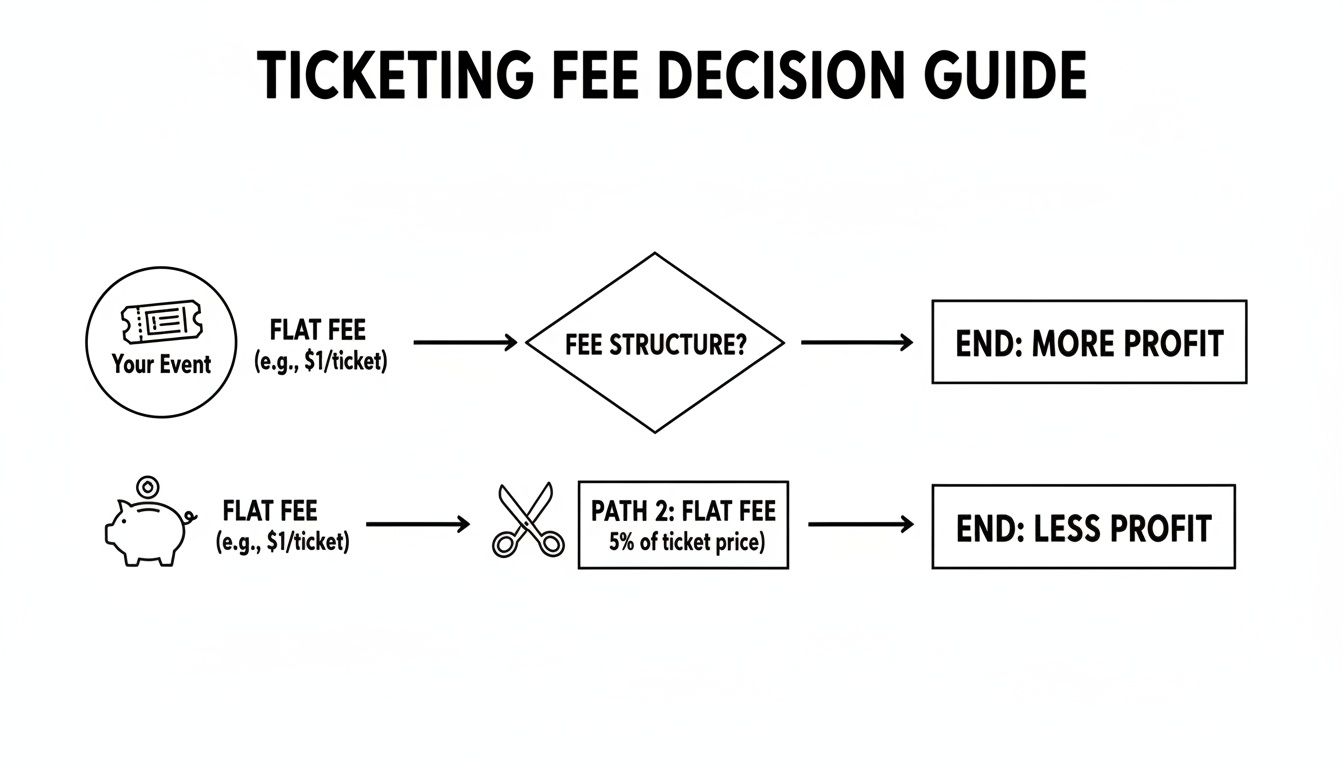
As the visual shows, a flat-fee model consistently leaves more money in your pocket.
Ultimately, customization is the killer feature. True white-label solutions let you control everything from branded emails to custom domains. This level of control is what makes them so powerful, whether you're selling to five people or five thousand.
How Real Creators Use It
Theory is great, but let's see how this actually works. A white label ticketing platform isn't just for giant festival promoters. It's a game-changer for real people.
Think of it like this: you could serve coffee in a generic paper cup, or you could serve it in a custom-branded mug. One is a transaction. The other is part of the experience.
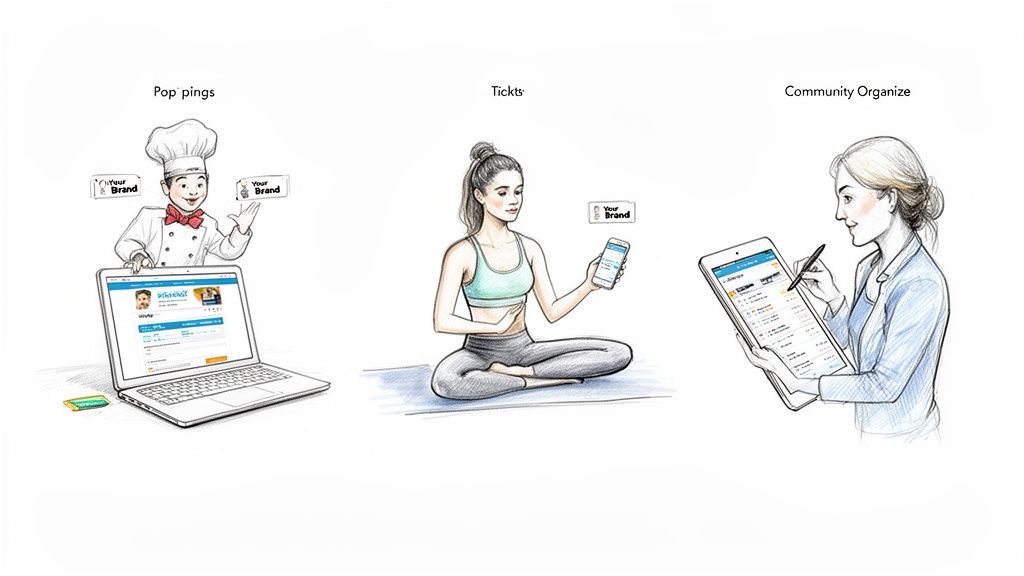
These are the stories of creators who are winning by focusing on their craft, not fighting with software.
The Pop-Up Chef's Supper Club
Meet Maya, a chef who hosts intimate, twenty-person supper clubs. She used to juggle bookings through Instagram DMs and a messy spreadsheet. It was chaos.
A big-name ticketing site made things worse. It sent her guests to a confusing page with ads for other restaurants, cheapening her brand.
Now, she uses a white label platform. She embedded a simple booking widget right on her website. It took her about ten minutes.
Her branding is front and center. The page uses her logo, her fonts, and her food photography. It feels like her.
Payments are a breeze. Guests pay securely without leaving her site, and payouts are fast and direct.
She owns the relationship. Maya now has a clean email list of every guest, making it easy to announce her next event.
For Maya, it’s not just about selling tickets. It's about owning the entire customer journey.
The Fitness Instructor's Weekly Classes
Then there's Alex, a fitness instructor who runs weekly outdoor classes. He was fed up with apps skimming a percentage off every class pass he sold. The fees were unpredictable and the apps were cluttered.
He switched to a platform with a flat-fee structure. Now, he has a clean, mobile-friendly page where clients can book a class in a few clicks. He keeps more of his hard-earned money and spends less time on admin.
The goal is to make the tech disappear. Your attendees shouldn't even notice the ticketing platform. They should only be thinking about your event.
This kind of control is becoming the new standard. White-label solutions are a huge driver of the smart ticketing market. Organizers are catching on to the power of full brand ownership and tools that make setup a breeze.
Is a White Label Platform Right for You?
Alright, should you be looking at a white-label ticketing platform?
It really depends on what you care about most.
Are you sick of watching a chunk of every sale disappear into percentage-based fees? Does it bother you to send your community to a generic, third-party site plastered with someone else’s brand?
If you're nodding along, you’re in the right place.
When to Make the Jump
A white-label platform is built for organizers who want to own their brand from start to finish. It’s for people who want to own their customer relationships, not rent them. And it’s for anyone who wants to own their revenue.
Think of the pop-up chef who wants a booking page as thoughtful as her plating. Or the workshop host who just needs a clean way to sell seats without the chaos of a giant marketplace.
The trade-off is this: you give up the built-in marketing machine of a huge platform. They won't feature you on their homepage. But in return, you get total control.
This path is for creators who are all-in on building their own community. You’re not trying to get discovered by strangers. You’re building your own audience and need tools to serve them directly.
If that sounds like you, then a white-label platform is a resounding yes. It’s a simple, honest tool built for people who care about their craft.
To dig deeper, check out our guide on finding the best alternative to Eventbrite for your needs.
Common Questions from Organizers
Thinking about making the switch? Smart move. Here are some of the questions we hear most often, with straight-up answers.
How Fast Can I Really Get Set Up?
Honestly? You can go from zero to selling tickets in minutes. The point of a good white-label platform is to dodge a massive technical project.
You create an account, pop in your logo, pick your brand colors, and set a price. That's it. No code needed. It’s built for people who are masters at creating experiences, not managing software.
What’s the Deal with Payment Processing?
It's simple and secure. When an attendee buys a ticket, their payment runs through a trusted gateway like Stripe. The money goes straight into your account.
The biggest difference here is how quickly you get paid. You don’t have to wait until the event is over to get your cash. For many creators, getting money as tickets sell is a massive help for cash flow.
This setup keeps your attendees’ financial info safe and gets you paid without weird delays.
What Happens If I Need Help?
Good support means talking to a real human when you need one. You should expect clear, helpful answers without getting trapped in a maze of chatbots.
Since the platform is built for creators, the support team usually knows the ropes. Need to figure out a discount code? Want to make sense of your sales data? That’s what they’re there for. You’re not just getting tech support; you’re getting a partner who understands what it takes to run an event for five attendees or five thousand.
Ready to stop sending your fans to someone else’s website? Ticketsmith helps you sell tickets under your own brand with simple, flat-fee pricing. Join the waitlist and be the first to know when we launch.