
You're the friend who throws the best parties. People still talk about that one dinner you hosted last year. That’s a great start. But turning that knack into an actual event planning business is a completely different game.
It might not be as complicated as it seems. Let's take a look..
From Party Host to Business Owner
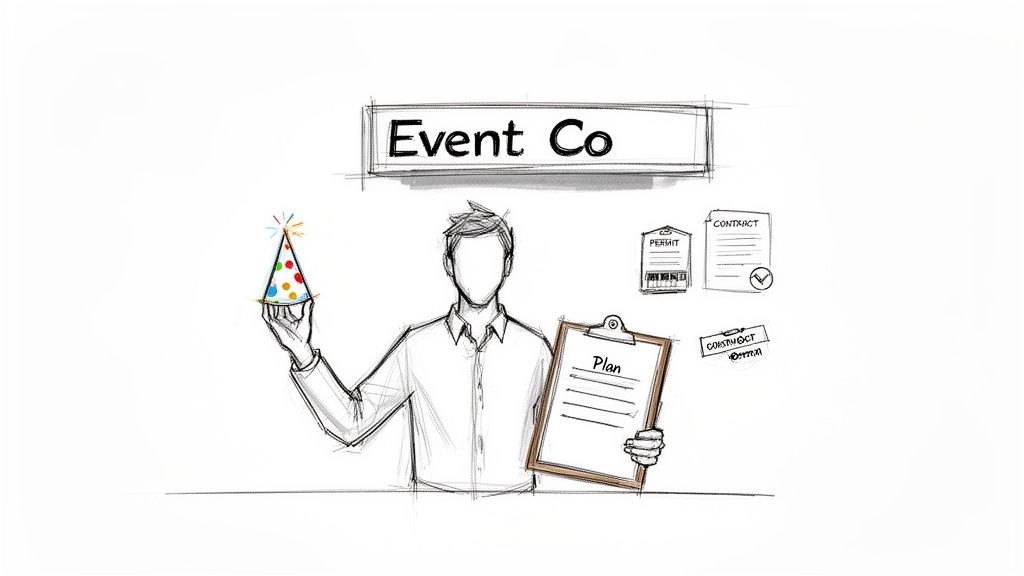
The biggest switch isn't getting more creative with themes. It’s learning to think like a business owner first and a planner second.
This means you swap your obsession with party favors for a fascination with profit margins, client contracts, and liability insurance. It’s less glamorous, sure. But it's what builds a business that lasts.
Find Your Niche (Seriously, Just Pick One)
You can't be the planner for everyone. Trying to organize a 500-person corporate gala one week and a 20-person wellness retreat the next is a recipe for burnout. You need a niche.
A niche is just the sweet spot where your skills meet a paying market.
Look around your town. Where are the gaps?
Lots of tech startups but nobody organizing good networking events for them?
Local artists who need someone to coordinate their gallery openings?
Could you specialize in zero-waste events for an eco-conscious crowd?
A solid niche solves a specific problem for a specific group. This makes your marketing a million times easier. You're no longer just another "event planner." You're "the person who organizes amazing pop-up dinners for local chefs." See the difference?
Tackle the Legal Stuff (Without the Headache)
Paperwork is boring. I get it. But ignoring it can be an expensive mistake. Getting your business structure and permits sorted out early saves you from massive headaches later. You don't have to overcomplicate it.
Business Structure: For most solo planners, a Sole Proprietorship or a single-member LLC is the simplest way to go. An LLC offers more liability protection, which is smart when you’re responsible for other people’s big days.
Permits & Licenses: These vary wildly by location. Your city’s small business office is your best friend here. They'll tell you exactly what you need for a home-based business, food handling, or liquor licenses.
The goal is to build a solid foundation so you can focus on creating amazing experiences, not wrestling with legal forms. A little structure now gives you a lot of freedom later.
The demand for skilled organizers is growing. The global events industry is projected to hit $2.5 trillion by 2035, driven by creators like pop-up chefs and workshop hosts. With 66% of professionals planning more events now, the opportunity is real. Smart planners are leaning on tools to keep up. 79% already use Event Management Systems to handle everything from registration to payouts.
You might find useful parallels in this guide on how to start a catering business, which covers similar practical steps for licensing and pricing.
Once the legal and financial basics are covered, you're ready for the fun part. Check out our guide on getting started for your next steps.
Pricing Your Services Without Guessing
Alright, let's talk money. Figuring out what to charge is often the biggest hurdle for new event planners. It can feel like pulling numbers out of a hat. I promise, it doesn't have to be.
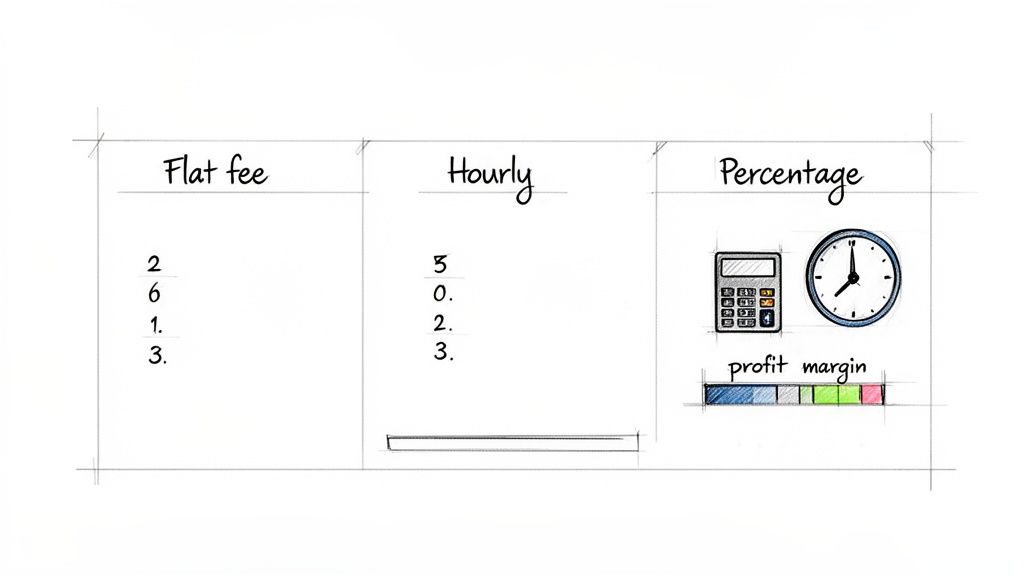
The goal is simple. You need to charge enough to build a real business, not just a stressful hobby. Let’s look at the three most common pricing models so you can stop guessing and start earning.
The Three Core Pricing Models
Most planners use a version of these three structures. Picking the right one just depends on the event and the client.
Flat Project Fee: This is one price for the entire event. It's perfect for clients with a predictable budget and for projects with a clear scope, like a one-day workshop. The focus is on the result, not the hours you clock.
Hourly Rate: You bill for every hour you put in. This works best for consulting gigs or for events where the scope is fuzzy and likely to change. An hourly rate protects you when a client's "little bit of help" turns into a much bigger job.
Percentage of Event Cost: Here, you charge a percentage of the total event budget, typically 15-20%. This is the go-to for large-scale events like weddings or big corporate functions where you’re juggling dozens of vendors.
There's no single "best" option. A smart planner uses all three, picking the right tool for the job.
Building Your First Quote: A Real-World Example
Let's get practical. Imagine you're hired to plan a "Sourdough for Beginners" workshop for a local baker. It's for 25 people. Here’s how you could build a flat-fee quote.
First, calculate your hard costs. These are the direct expenses for the event itself.
Venue Rental: $300 for four hours
Ingredient Kits: $15 per person x 25 = $375
Printed Handouts: $2 per person x 25 = $50
Coffee & Snacks: $100
That brings your Total Hard Costs to $825.
Next is your management fee. This is what you get paid for your time, expertise, and sanity. A rookie mistake is to only charge for the event day itself. You have to account for all the work before and after.
Don't just charge for the hours you're physically at the event. You're getting paid for the hours spent planning, the vendor relationships you've built, and the problems you solve before the client even knows they exist.
Let’s say this workshop will take you 30 hours total. If your target hourly rate is $50, your base management fee is $1,500.
Now, let's put it all together.
Hard Costs: $825
Your Management Fee: $1,500
Contingency (10%): $232.50 (for little surprises)
Total Client Quote = $2,557.50
See? That number isn't a guess. It’s based on real costs and the value of your time. This method gives you a clear price you can explain confidently. For a deeper dive, our guide on budgeting for an event breaks down how to track every dollar.
Talking About Money With Confidence
Finally, you have to present the price. Never apologize for it. You’re running a business, not a charity.
When you send a proposal, frame the cost in terms of value. Explain what the client gets for their money. A stress-free experience. A professionally run event. The freedom to actually enjoy their own party. Confidence sells. And when you’ve done the math, you have every reason to be confident.
Getting Your First Clients
Okay, you've sorted out the business basics and figured out what you're worth. Now, where do the actual clients come from?
Forget about billboards or dumping money into ads. Your first clients will almost always come from scrappy, real-world effort. This isn't about spamming your friends. It's about showing people what you can do, starting small, and building momentum.
Tap Your Network (Without Being Annoying)
Everyone says to "use your network," which often feels vague and a little gross. Let's make it practical. You're not begging for a job. You're just letting people know what problem you solve.
Instead of a generic "Hey, I'm an event planner now!" post, get specific. Frame it as a low-risk offer to help people you know.
"Thinking of hosting a workshop this fall? I'm putting together a few launch packages to help local creators handle the logistics. Happy to chat if you're curious."
"My friend is launching her pop-up bakery, and I'm helping her plan the opening party. It got me thinking—if any other local businesses need a hand with a launch event, I'd love to help."
This approach isn't a hard sell. It’s a gentle reminder of what you do, framed as a solution to a problem they might have. People are much more likely to respond to a specific offer.
Your First Event Is Your Best Marketing
Your first successful event, no matter how small, is your golden ticket. It's concrete proof you can deliver. Don't wait for a huge gig to fall into your lap. Find a low-risk opportunity to create a killer case study.
Offer to plan a small charity fundraiser, a local art show, or a community market. These events are great because they have a built-in "good cause" angle that makes people want to get involved.
Your goal for this first event isn't to make a huge profit. It's to get stunning photos, glowing testimonials, and a real example of your work. One well-documented success story is worth more than a thousand business cards.
Pull together a small "launch team" of reliable friends. Ask them to help spread the word and volunteer on the day of. Their genuine enthusiasm creates a buzz you can't buy. Afterward, you'll have everything you need for your website and social media.
Create a Simple Website That Works
You don't need a fancy, ten-page website. All you need is a simple one-page site that does one thing well. It convinces potential clients to get in touch.
Here’s what your one-pager must have:
Who you help: A clear headline like, "Stress-Free Event Planning for Pop-Up Chefs and Local Creators."
What you do: Briefly list your key services. Workshop logistics, launch parties, community markets.
Proof you're good at it: This is where you put those awesome photos and testimonials from that first event.
A clear call to action: A simple "Let's plan your event" button that links to your email or contact form.
That's it. Your website is a tool to showcase your work and make it easy for someone to hire you.
Use Social Media to Show, Not Just Tell
Your social media isn't just for pretty pictures. It's for telling the story of the events you create.
Show behind-the-scenes content of you setting up. Feature the amazing vendors you worked with. Share quotes from happy attendees. When people see the care you put into an event for 50 people, they'll trust you can handle their event for 500.
Consistent, authentic storytelling builds an audience that is genuinely interested in what you do. For more ideas, read up on effective event promotion strategies.
Managing the Nuts and Bolts of an Event
This is where the real work begins. Forget the vision boards for a second. This is the gritty, operational side that turns a great idea into an unforgettable experience. It’s all about checklists, wrangling vendors, and mastering communication.
The success of your event planning business hinges on flawless execution. A brilliant concept is worthless without a rock-solid plan. This is the behind-the-scenes hustle that separates pros from amateurs. It’s less about picking the perfect napkin and more about making sure the napkins actually show up on time.
Build Your Event Day Bible
Every event needs a master plan. This is your single source of truth that you, your team, and your client can rely on. This document holds every detail, from vendor arrival times to the Wi-Fi password.
Don’t try to keep this stuff in your head. The moment you think, "Oh, I'll remember that," is the moment you've doomed yourself to forget it. To keep every detail locked down, a comprehensive Event Planning Checklist Template will be your best friend.
Your master plan should include:
A Detailed Timeline: Not just "doors open at 7 PM." I mean a minute-by-minute schedule for the entire day, covering setup, staff briefings, the main event, and breakdown.
Vendor Contact Sheet: Every name, cell number, and arrival time for your caterer, AV tech, florist, and everyone else.
Key Personnel Roster: Who is doing what? List names and specific roles so there’s zero confusion.
This document isn’t just for you. Share it with your client and your team. Clarity is the ultimate antidote to chaos.
Speaking of plans, you need one for getting clients. The journey from starting out to scaling your business is a process.
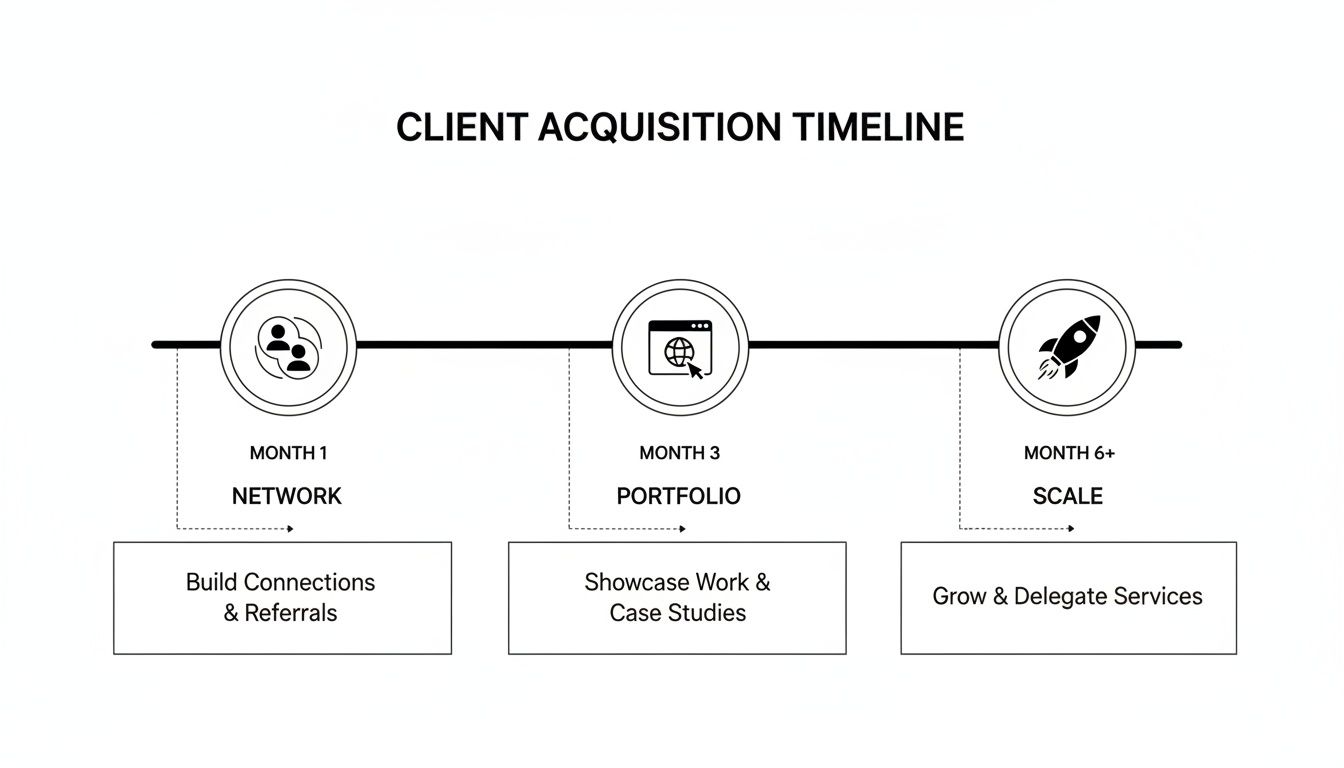
This timeline shows how an event planning business is about layering successes. It starts with relationships, then proving your value with a solid portfolio, and finally, expanding your reach.
Essential Event Planning Checklist
Here’s a simplified checklist that breaks down the major tasks by timeline. This isn't exhaustive, but it covers the core milestones you'll need to hit.
| Timeline | Task | Key Consideration |
|---|---|---|
| 3+ Months Out | Define event goals & budget | What does success look like? Be realistic with numbers. |
| Select date & venue | Check for conflicting local events. Does the venue fit the event? | |
| Create master event plan | This is your "Event Bible." Start building it now. | |
| 2-3 Months Out | Book key vendors (caterer, AV, entertainment) | Top vendors get booked fast. Get contracts signed. |
| Launch event website & ticketing | Make it easy for people to find info and buy tickets. | |
| Start initial marketing & promotion | Build buzz early with social media and email. | |
| 1 Month Out | Finalize guest list & send invitations | Have a clear RSVP deadline. |
| Confirm all vendor details | Re-confirm arrival times, needs, and final payments. | |
| Plan event layout & flow | Where will people check in? Where's the bar? Walk through it. | |
| 1 Week Out | Final walkthrough of the venue | Check everything. Power outlets, restrooms, lighting. |
| Send final details to attendees | Remind them of the time, place, and parking. | |
| Prepare on-site materials (signage, name tags) | Don't leave this to the last minute. | |
| Day Of | Conduct team briefing | Make sure everyone knows their role and the timeline. |
| Manage vendor setup | Be the single point of contact for all vendors. | |
| Execute event timeline | Stay calm, be flexible, and solve problems as they arise. | |
| Day After | Send thank you notes (client, vendors, guests) | A little gratitude goes a long way. |
| Conduct post-event debrief | What went well? What could be better next time? | |
| Finalize payments & close budget | Settle all outstanding invoices. |
Remember, a good checklist is a living document. Adapt it for each event you plan.
Taming the Ticketing Beast
Alright, let's talk about getting paid. Selling tickets seems simple, but it’s an area where many new planners trip up. The platform you choose can be a dream or a total nightmare.
Many big ticketing platforms look great on the surface, but they secretly skim a percentage of every ticket you sell. Those "service fees" add up fast, eating into your profits and irritating your guests. A $40 workshop ticket suddenly becomes $45 at checkout.
Don’t let hidden fees kill your bottom line before the doors even open. Your ticketing system should work for you, not against you.
My advice? Find a tool with flat fee pricing. This way, you know exactly what you’ll pay per ticket. No nasty surprises.
The right platform lets you set up in minutes without any code. You can add your own custom branding so the page looks like your event, not some generic site. And when it's over, you need fast, secure payouts. You shouldn't have to wait weeks for your money.
The Post-Event Follow-Up
The job isn't over when the last guest leaves. The days after are crucial. A smart follow-up can turn one-time attendees into loyal fans and current clients into repeat business.
Ditch the generic "Thanks for coming!" email. Add value.
Share a link to a photo gallery.
Ask for feedback with a simple, one-question survey.
Announce the date for your next event to build early buzz.
For your client, a post-event wrap-up report is essential. Send them a clean summary with key stats like attendance, money raised, links to press, and positive attendee feedback. This proves your value and sets the stage for your next project together.
Scaling Your Business Beyond One-Off Gigs
So, you’ve pulled off a few successful events. The positive feedback is rolling in. But right now, you're a person who plans events, not a business owner. To build a real business, you have to stop trading every single hour of your time for money.
The big shift is moving from a busy freelancer to a true business owner. That means building systems that let you take on more work without you personally having to do everything. It’s about creating an engine, not just spinning faster on the hamster wheel.
If you spend all your time chasing down vendors for one event, you have zero time to book the next one. This leads to the feast-or-famine cycle that burns out so many talented planners. It's time to think bigger.
When to Hire Your First Helper
Hiring someone feels like a massive leap. But you don't need a full-time employee. Your first hire should be a freelance contractor you can bring in on an event-by-event basis.
When’s the right time? When you start dropping balls. Or just before that happens. If you find yourself double-booking consultations or feeling perpetually overwhelmed, that's your cue.
Start by handing off repeatable tasks.
Social media scheduling: Someone else can create and schedule posts.
Initial client inquiries: A contractor can handle first-response emails and get calls on your calendar.
On-site event support: Managing guest check-in or setting up decorations are perfect tasks to delegate.
Bringing on a contractor for just five to ten hours a week can be a game-changer. It frees you up to focus on what actually grows your event planning business: building client relationships and designing incredible experiences.
Creating Repeatable Systems
Here's a hard truth: you can’t delegate chaos. Before you bring anyone else in, you need to standardize your process. This means creating a documented workflow for every event. This isn't about soul-crushing bureaucracy. It’s about creating a playbook so things run smoothly, whether it’s you or a contractor running the play.
Think through the entire lifecycle of an event and create a checklist for each stage.
Client Onboarding: What are the exact steps from the first email to a signed contract? Write them down.
Vendor Management: How do you find, vet, and communicate with vendors? Document it.
Event Day Execution: What does your standard run-of-show template look like? Make one.
Post-Event Wrap-Up: What’s your follow-up process with clients and attendees? Systematize it.
Your systems are what make your business scalable. A good process ensures every client gets the same high-quality experience, even as you grow. It's the difference between building a business and just creating a job for yourself.
These checklists don’t need to be fancy. A messy Google Doc is perfectly fine. The point is to get the process out of your head and onto paper. To learn more, check out our guide on scaling your event business.
Moving to Recurring Revenue
The best way to scale is to create services that aren't tied to a single event. This introduces predictable, recurring revenue.
Instead of only planning one-off gigs, think about adding offerings like these:
Consulting Packages: Offer a four-hour "Event Strategy Session" for a flat fee. Clients get access to your brain without you managing their entire event.
Workshop Series: Don't just plan one workshop. Create a three-part series and sell tickets for the whole thing upfront. This is a great model for pop-up chefs or artists you partner with.
Vendor Curation Service: Charge a monthly retainer to help new venues build out their list of preferred vendors. You’ve already done the work and built the relationships.
This approach transforms your business model. You’re no longer just selling your time. You’re selling your expertise in packages that are easier to deliver and scale.
Got Questions? Every New Event Planner Does.
You've got the vision, you've crunched the numbers, and you're itching to get started. But I bet a few nagging questions are still rattling around in your head. That's totally normal.
Let’s tackle some of the most common ones. No fluff, just straight answers.
How Much Money Do I Actually Need to Start?
Probably a lot less than you think. You can get an event planning business off the ground with just a few hundred dollars. Seriously.
Your first costs are just the bare essentials:
A simple business license from your city.
A basic, one-page website to show you're legit.
General liability insurance (do not skip this).
That’s pretty much it. You don’t need a fancy office or expensive software. Your biggest investment at the start is your own time and hustle. Focus on landing one small gig and use the profit to fund your next move.
Do I Need a Certification to Be an Event Planner?
Short answer: nope. Clients care about your portfolio and your results, not a piece of paper.
A beautifully executed event for 50 people is a far better credential than any online course. Your energy is better spent getting real-world experience, taking amazing photos, and collecting testimonials from happy clients.
Your work is your proof.
What Is the Biggest Mistake New Planners Make?
This one’s easy. Underpricing their services and not having a rock-solid contract. It's tempting to take any job for any price just to get your foot in the door.
Don't fall into this trap. It devalues your work and attracts the most difficult clients. You'll end up overworked, underpaid, and burned out.
Always, always, always use a contract. It needs to clearly outline the scope of work, your payment schedule, and what happens if the event gets cancelled. A contract isn't about mistrust. It’s about professional clarity. It protects you and your client.
The second biggest mistake is trying to do everything yourself. Learn to delegate simple on-site tasks to a trusted friend or hire a day-of contractor. You can't be everywhere at once.
How Should I Handle Ticketing for My Events?
How you sell tickets and get paid can make or break your profit margin. My advice? Avoid platforms that skim a percentage off every ticket sale. Those "service fees" eat into your revenue fast and annoy your attendees.
Instead, look for a ticketing tool with straightforward, flat fee pricing. You want something that lets you create a professional-looking event page with your own custom branding in minutes, no coding needed.
The best systems are built for real people, whether they host events for five or five thousand attendees. And just as important, they offer fast, secure payouts straight to your bank account. Your ticketing process should be easy for your guests and even easier for you.
Starting your Ticketsmith box office is the simplest part of the whole process. Set up your event in minutes, create a page that looks like yours, and enjoy fast, secure payouts without hidden fees. We built this for the workshop hosts and pop-up chefs who just want to create amazing experiences. Get started at ticketsmith.co.