
You’re probably here because Eventbrite's fees are eating into your budget. It feels like a small nick at first. But those percentage cuts add up fast, especially when you’re running a small workshop or a pop-up dinner. You pour your heart into creating an incredible experience, only to watch a slice of your revenue get skimmed right off the top.
It's no wonder so many creators are looking for a better way.
Why You're Looking for Eventbrite Alternatives
You didn't start hosting events to become an expert in confusing fee structures. You did it to share a passion. Maybe that’s teaching a pottery class, running a supper club, or organizing a local market. But as your events get bigger, the cracks in a platform like Eventbrite start to show.
The online ticketing world is massive. It’s on track to hit $12.5 billion in the U.S. alone. Yet for the small-time organizer, the big platforms often feel like they're working against you. Those per-ticket fees, like 2.5% + $0.99, can demolish the thin margins on a $20 fitness class. (You can dig into the market research on this trend here).
The Main Frustrations
When I talk to organizers, their frustrations usually fall into three buckets:
- Death by a Thousand Fees: It’s never just one fee. It's a service fee plus a payment processing fee. It's nearly impossible to predict what you'll actually take home.
- Branding That Isn't Yours: Your event page is plastered with Eventbrite's logos and links. It constantly reminds attendees they’re on a third-party site. This dilutes your brand and can feel a bit amateur.
- A Clunky Experience: The interface can be a maze for both you and your ticket buyers. You just want to sell tickets, not spend an hour clicking through settings.

This kind of pricing model essentially penalizes you for growth. The more successful you become, the more they take. It’s exactly why platforms with simple, flat-fee pricing are catching on with independent creators. They just want to be paid fairly for their work.
Let's Talk About Event Ticketing Fees
Ever notice how ticketing platforms love to shout about being "free for free events"? It's a great headline, and it's true. But the moment you charge for all your hard work, the story changes. The fees show up, and they are rarely simple.
Suddenly, you're untangling a multi-layered headache. There’s a service fee, which is a slice of your ticket price. Then there's a payment processing fee, another percentage. And often, a fixed fee gets tacked on top for good measure.
It’s a messy formula. It feels designed to skim right off your top-line revenue.
Take a $30 ticket for a workshop. It’s not unusual to lose over $2.50 of that to fees. That might not sound like a huge deal. But sell 50 tickets, and you’ve just handed over $125. That's money that could have paid for supplies, a better venue, or your rent.
The Sneaky Cost of Percentage Fees
This model is everywhere in the massive online event ticketing market, a space valued at around USD 72.84 billion. Major platforms can charge organizers hefty service fees, sometimes up to 6.5% on top of payment processing. It's a huge reason why so many people are hunting for alternatives to Eventbrite that promise flat fees and no nasty surprises. (You can see more on the ticketing market here).
Let's run the numbers on a few real-world scenarios.
Scenario 1: The Yoga Instructor You host a weekly yoga class and charge $20 per spot. You sell twenty-five tickets.
- With Percentage Fees (e.g., 3.7% + $1.79 + 2.9%): You could lose around $2.71 per ticket. That's $67.75 gone from your total revenue of $500.
- With Flat-Fee Pricing (e.g., $1 per ticket): Your total fee is just $25. You just kept an extra $42.75.
Scenario 2: The Pop-Up Chef You’re hosting an exclusive supper club. Tickets are $100 each, and you sell thirty.
- With Percentage Fees: The platform could take over $7 per ticket. That’s a staggering $210+ skimmed right off the top.
- With Flat-Fee Pricing: You pay $30 total. The savings are massive.
The problem with percentage-based fees is that they penalize you for your success. The more you charge or the more tickets you sell, the bigger their cut becomes. It just doesn't feel right.
Why Predictability Matters More Than You Think
Flat-fee pricing isn't just about saving money. It's about predictability.
You know exactly what you’ll pay per ticket. It works whether it’s for a five-person knitting circle or a five hundred-person indie music gig. You can finally budget accurately and price your tickets fairly without doing complex math to figure out your costs.
This straightforward approach is just better for small creators. You pour your heart into your events. You deserve a ticketing partner that helps you keep the money you earn.
Setting up a ticketing page should take minutes. It should connect directly to your bank for fast, secure payouts. And it should look like your brand, not someone else's.
By the way, if you’re still mapping out your event, you might find some helpful tools in our guide to free event planning software. Getting the planning right from the start makes managing the finances a whole lot easier.
Comparing the Top Eventbrite Alternatives
Alright, let's get into the weeds. This isn't just another list of apps. We’re doing a practical, no-fluff comparison of real alternatives to Eventbrite, focused on what actually matters to a small creator. We'll look at the key players and how they stack up on the stuff that hits your wallet and your brand.
We’re going to compare a few top options: Ticketsmith, TicketTailor, and Universe. We'll also touch on a DIY approach. The goal is to see how they perform on pricing, ease of setup, branding control, and how quickly you get your money.
The Head-to-Head Smackdown
Let's be direct. You need to see how these platforms compare side-by-side.
One platform’s idea of “custom branding” is letting you change a banner color. Another gives you a page that genuinely looks and feels like it’s yours. Those differences are huge when you’re building a loyal following.
This visual shows the basic math of ticket fees: what you charge, what the platform takes, and what you actually keep. It’s pretty simple. But seeing it laid out makes the impact of percentage-based fees crystal clear.
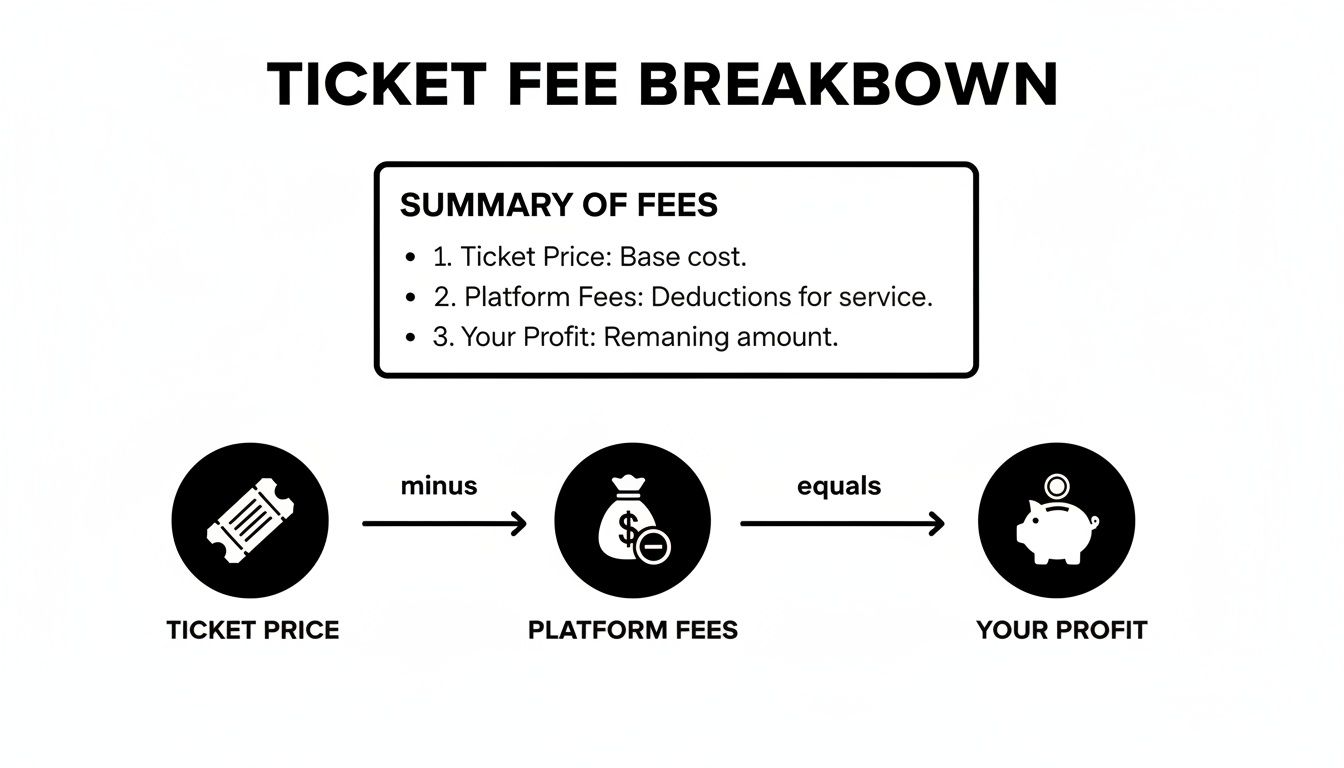
The key takeaway is that percentage-based fees create a variable, often unpredictable, dent in your profit. A flat fee is beautifully predictable.
Eventbrite Alternatives Feature Smackdown
To make this dead simple, here’s a direct comparison of the features that small event organizers actually care about. Forget the fluff. This is about cost, control, and cash flow.
| Feature | Eventbrite | Ticketsmith | TicketTailor | Universe (by Ticketmaster) |
|---|---|---|---|---|
| Pricing Model | Percentage + Fixed Fee | Flat Fee per Ticket | Monthly Fee or PAYG | Percentage + Fixed Fee |
| Branding Control | Limited (Eventbrite logos everywhere) | Fully customizable, looks like yours | Good, mostly white-label | Some customization, but has TM feel |
| Ease of Setup | Moderate, can be clunky | Under 10 minutes, no code | Simple and straightforward | Moderate, geared for larger events |
| Payout Speed | 4-5 days after event ends | Fast, direct to your account | Direct via Stripe/PayPal | 5-8 days after event ends |
As you can see, the differences aren't subtle. Platforms like Eventbrite and Universe are built around a percentage-take model. Ticketsmith and TicketTailor put predictable costs front and center.
Understanding the Nuances
A table gives you the quick version, but the real story is in the details.
Ticketsmith is built for the independent creator. The setup is designed to take minutes, not hours. You connect your bank, build a page that reflects your brand, and you’re live. Because it’s a simple flat fee, you always know your costs upfront. It’s ideal for everything from a five-person workshop to a 5,000-person festival.
TicketTailor offers a different model. You can pay a monthly subscription or a small pay-as-you-go fee per ticket. This can be great if you have a steady stream of events. Their branding options are strong, giving you a professional-looking page.
Universe, owned by Ticketmaster, feels a bit more corporate. It's powerful and can handle complex events, but the fee structure is similar to Eventbrite's. You'll likely see their branding on your pages, and the interface can feel like a bit much if all you want to do is sell tickets for a pop-up dinner.
Is the platform built to serve you, the creator, or is it built to serve its own brand and bottom line? Flat-fee models and true white-label branding put your success first.
What About a DIY Solution?
For some, using a tool like Squarespace or another one of the leading ecommerce platforms for small businesses combined with a scheduling app seems appealing. You get total brand control, which is great.
However, this approach often falls short on the event-specific features you'll eventually need. Think easy check-in, attendee management, and automated reminders. Piecing together different apps can quickly become a technical headache that costs you more in time than you save in fees. If you're serious about selling tickets, finding the best way to sell tickets usually involves a dedicated platform.
Ultimately, choosing the right tool depends on your priorities. If predictable costs, fast setup, and a page that looks like yours are at the top of your list, then a modern, flat-fee platform is probably your best bet.
Choosing the Right Alternative for Your Event
The best tool for a pop-up chef isn't the best for a weekly fitness class. Generic advice is useless. Let's get specific and figure out which of the alternatives to Eventbrite actually fits what you do.
We’ll break this down by looking at three common types of organizers. See which one sounds most like you. This is about finding the right platform for the events you pour your heart into.
The Workshop Host
You host recurring events. Maybe a pottery class every Thursday or a coding bootcamp once a month. Your biggest needs are simplicity, a smooth check-in process, and a way to build a loyal community without friction.
- What you need: Solid support for recurring events, easy attendee management, and a branded page that your regulars recognize instantly. You also need fast payouts so you're not waiting weeks for last month's class revenue.
- Recommendation: A platform like Ticketsmith is built for this. The flat-fee pricing means your costs are predictable, whether you sell five seats or 50. You can set up a recurring event once and let it run. The custom branding makes your page look like your business, not a generic ticketing site.
The goal is to make the tech disappear so you can focus on teaching. Your students should be able to book a spot in two clicks without getting lost on a cluttered third-party marketplace.
The Pop-Up Chef or Supper Club Organizer
Your events are unique, one-of-a-kind experiences. You sell out fast and rely on word-of-mouth and stunning visuals. Your ticketing page needs to reflect the quality of your food and atmosphere. A clunky, ad-filled page from a big corporation just kills the mood.
- What you need: Gorgeous, customizable event pages that work on mobile. You need a setup so fast you can launch a new event page in minutes after dreaming up a menu. And you need a system that gets money into your account quickly to cover ingredient costs.
- Recommendation: A dedicated, brand-focused platform is your best bet here. You need full control over the look and feel. The ability to create a beautiful, simple page with zero outside branding is non-negotiable. Flat fees are also a huge win, ensuring a bigger slice of that $100 ticket price goes to you, not a platform.
For one-off events, brand perception is everything. The moment a guest clicks to buy a ticket, they're forming an opinion. A clean, professional page builds trust and anticipation.
The online event ticketing world is projected to hit USD 114.81 billion by 2032, largely because small, creative events are booming. But Eventbrite's model often frustrates pop-up coordinators who need control without chaos. Alternatives shine with no-code setup and direct deposits. You can learn more about the growth of the digital ticketing market and its impact on small events.
The Community Organizer
You're the local hero running the neighborhood market, a charity fun run, or a small music festival. You might be juggling volunteers, multiple ticket tiers, and communicating with hundreds of people. Your budget is tight, and every dollar saved on fees goes back into the event.
- What you need: Scalability and flexibility. You need a tool that works just as well for 50 attendees as it does for 5,000. You also need strong attendee management features and maybe the ability to collect donations.
- Recommendation: Look for a platform with flexible ticket tiers and robust back-end tools. While some nonprofit-specific platforms exist, a versatile tool like Ticketsmith can handle the scale without locking you into a niche system. A predictable flat fee makes budgeting for your community event so much easier.
If you’re still weighing your options, our guide on choosing the best ticketing platform for events offers a deeper comparison of features to consider. Ultimately, the best tool gets out of your way and helps you bring people together.
How to Switch Platforms Without Losing Your Mind
So, you've picked a new platform. Now what? The thought of moving everything can feel like a monster task. But it's honestly way easier than you think.
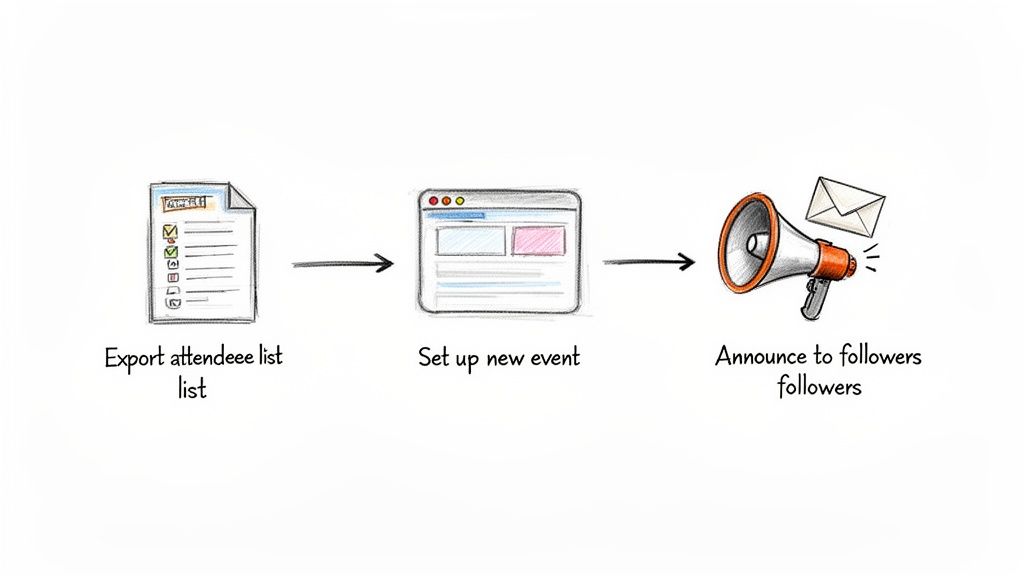
Think of this as your quick-start guide to a smooth transition. We'll walk through the practical steps to get you from your old setup to a new, beautifully branded ticketing page that you actually own. You can get this done in less time than it takes to brew a pot of coffee.
Step One: Get Your Data Out
First, let's grab your attendee list from Eventbrite. This data is yours, and it's your most valuable asset. It's the list of people who have already shown up for you.
Exporting is pretty straightforward. Head into your past events, find the reporting tools, and download your attendee summary as a CSV file. This file will have names, emails, and ticket types.
Tuck this file away somewhere safe.
Step Two: Set Up Your New Home in Minutes
Now for the fun part. The best alternatives to Eventbrite are built for speed. You’re not coding a website from scratch. Platforms like Ticketsmith are designed so you can get your first event live in under ten minutes. No code needed.
Here’s what that usually looks like:
- Connect Your Bank Account: This is how you get paid. A solid platform will use a secure processor like Stripe to send fast, secure payouts directly to you. No more waiting for days after your event.
- Create Your Event Page: Add your event title, a compelling description, and a great photo. This is where you get to customize the branding so it looks and feels like your event.
- Set Your Ticket Tiers: Create your ticket types—General Admission, Early Bird, VIP. Set your prices. With flat-fee pricing, your costs are simple and predictable from the start.
The goal of a modern ticketing tool is to make the technology disappear. It should feel intuitive and get out of your way so you can focus on creating an amazing experience.
If you want to dive deeper, our guide on setting up online registration for events has a few more pro-tips to make the process even smoother.
Step Three: Tell Your People
You've made the switch. Time to let your loyal followers know about your new ticketing home. Don't overthink this. A simple, direct announcement is all you need.
Post on your social media channels and email that list you exported from Eventbrite. Let them know you've moved to a new system that makes buying tickets easier and helps you keep more of the revenue from your events. People genuinely love supporting creators directly.
Here’s a simple email template you can borrow:
Subject: A small (but great!) change to our event tickets
Hi everyone,
Exciting news! I’ve moved my event ticketing to a new platform to make things a little smoother for everyone.
From now on, you can grab tickets for all my upcoming [workshops/dinners/classes] at my new, easy-to-use page here: [Link to your new ticketing page]
Thanks for your amazing support. It means the world.
Best, [Your Name]
That’s it. You’re done. You’ve successfully moved off a platform that was skimming your profits and onto one that puts you back in the driver's seat.
Questions We Hear All The Time About Switching
Thinking about a move is one thing. Actually doing it brings up a bunch of practical questions. Here are the ones we hear most often, with some straight-up, no-fluff answers.
Will I Actually Save Money if I Ditch Eventbrite?
For almost any paid event, the answer is a resounding yes. The savings come from completely sidestepping those percentage-based service fees that slowly eat away at your revenue.
Think about it: on Eventbrite, a $50 ticket can end up costing you around $3.25 in fees. On a flat-fee platform, you might only pay $1. That difference adds up faster than you'd think.
We always tell people to run the numbers on one of their past events. The math usually speaks for itself.
Is Setting Up a New Ticketing System a Huge Pain?
Not anymore. The best alternatives out there are designed to be ridiculously simple. You absolutely don't need to be a tech wizard or know any code.
Platforms like Ticketsmith are built for real people who are busy planning actual events. You can connect your bank account, whip up a branded event page, and start selling tickets in about ten minutes. The whole point is to make the tech fade into the background.
What Happens to My Customer Data if I Switch?
Your customer data is yours. Full stop. Most platforms, Eventbrite included, let you export your attendee lists and past sales reports.
When you migrate, you can just import that list to keep all your history in one place. Any good ticketing partner should make it dead simple for you to access and manage your own data. After all, they're your customers, not the platform's.
You did the work to build your audience. You should own that relationship and the data that comes with it.
Globally, the online ticketing market is a massive USD 61.57 billion industry. With over half of all ticket sales now happening on mobile, your audience expects a quick, painless checkout. Modern, simple platforms are built for this. You can read more about the growth of online ticketing on maximizemarketresearch.com.
And it's not just about selling tickets. Getting familiar with various event discovery platforms can give your event a serious visibility boost and help you tap into entirely new audiences.
Can These Alternatives Handle Larger Events?
Yep. Many of them are built to scale right alongside you. While they're perfect for a small workshop, the technology under the hood can handle events with thousands of attendees.
The infrastructure for fast, secure payment processing and reliable digital check-in works just as well whether you have fifty guests or five thousand. A great platform grows with you. You won't have to switch again when your little community event suddenly becomes the talk of the town.