
So, what's a "General Admission" ticket? Here's the plain-English version.
A General Admission (GA) ticket usually gets you into a specific concert area without giving you a specific numbered seat. At many shows, that means the floor is open and your place is first come, first served. In some venues, it means unassigned seats in a designated section instead. The part that trips people up most is this: GA guarantees access to the area on your ticket, not a guaranteed spot close to the stage.
How We Evaluated What General Admission Means at a Concert
The review draws on three elements: how major ticketing platforms define GA, how real venues describe their entry and seating policies, and how concert entry works in practice. I compared common ticket language used by platforms and venues with first-come, first-served guidance like EventBookings' explanation of general admission seating, then checked those definitions against the way fans experience a show on the ground.
I also reviewed venue operations guidance where it affects the fan experience, especially crowd flow, capacity, and accessibility. For that side, practical standards from sources like the ADA requirements for assembly areas and event crowd-planning resources helped separate ticketing jargon from what attendees need to know before they arrive.
The result is intentionally concert-specific. Instead of treating GA like a generic event setup, the key questions buyers ask are whether GA means standing or seating, how early arrival changes your view, what GA means on a ticket, and what to expect from the moment you buy through the moment you find your spot inside.
What Is General Admission, Really?
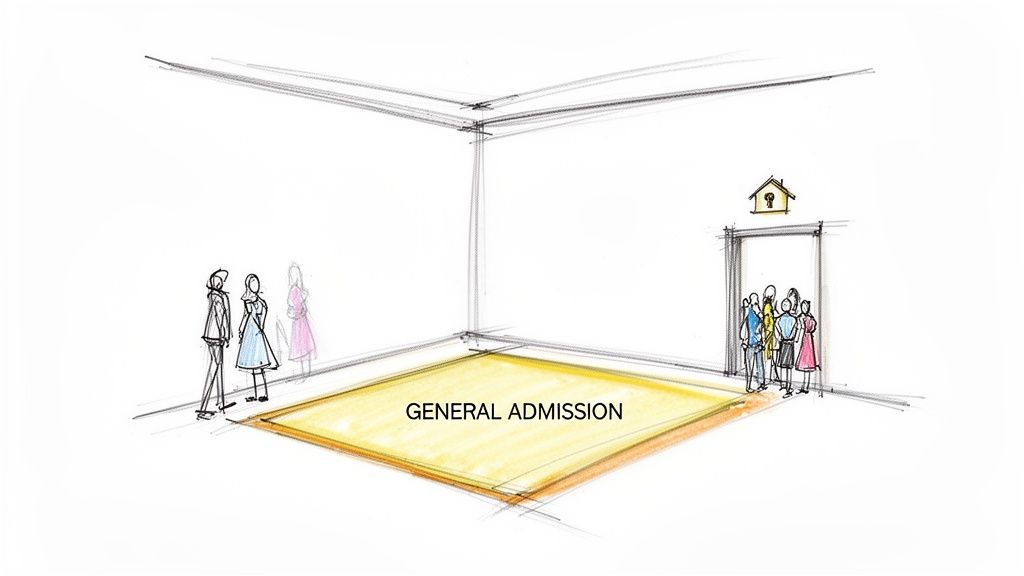
At a concert, general admission usually means you’re buying access to an unassigned area rather than a numbered seat. Most often, that’s a standing floor in front of the stage. Sometimes it’s a block of unreserved seats, like bleachers or open rows in a balcony section. Either way, your ticket gets you into that area, but it does not lock in an exact place, exact view, or exact amount of personal space.
That distinction matters. If your ticket says GA Floor, you’re not buying row 3, seat 11. You’re buying the right to enter the floor and choose a spot from whatever is still available when you get in. If your ticket says GA Seating, you’re usually free to take any open seat within that GA section, not anywhere in the whole venue.
For fans, GA is mostly about trade-offs: lower price and more freedom in exchange for less certainty. Buyers usually don’t need a lecture on venue operations; they need to know whether they should line up early, whether they’ll be standing all night, and whether a late arrival means a worse view.
Here’s how a GA floor often works when doors open: fans queue outside, tickets get scanned, security checks bags, and the people who enter first claim the closest places near the barricade. Even a short delay can make a noticeable difference at a sold-out show. A floor ticket does not automatically mean you’ll be near the stage.
An unreserved GA seating setup is different. In a smaller venue or amphitheater with a section marked GA, you can pick any empty seat in that section, but not seats in reserved rows or premium areas. That’s why the exact ticket label matters more than the phrase itself.
What should you expect the moment you buy a GA ticket? Expect entry to a specific section, first-come placement within that section, and venue rules that can affect your result—door time, bag policy, security screening, and sometimes wristbands or re-entry restrictions.
The Core Idea of GA
General admission is one of the simplest ticket formats: access first, exact placement second. That simplicity is a big reason it remains so common. According to Statista's live music data, average live music ticket prices have climbed sharply since 2011, which helps explain why GA remains attractive to fans looking for a lower-cost way into big shows.
Here’s what that usually means in practice:
- For attendees: You’re choosing from the spots available when you enter, whether that means open floor space or open seats in a designated area.
- For organizers: You set capacity by section instead of assigning every individual place.
It’s a straightforward system. Taking a minute to understand general admission seating will help you decide if a ticket label matches the experience you want.
The Different Flavors of General Admission
General admission can describe a few different setups, and the wording on the ticket matters. The same two letters—GA—show up on ticket listings, wristbands, venue maps, and checkout pages, but they do not always point to the exact same experience.

Quick definition: GA is the standard shorthand for general admission. If you see GA Floor, GA Pit, or GA Seating, read the second word closely. That’s the part telling you what kind of access you actually bought.
Standing Room Only
This is the version commonly meant when referring to a general admission concert. A GA standing ticket typically gives you access to the floor or pit without an assigned spot. You are free to stand where space is available, and how close you get depends heavily on when you arrive.
For fans, this is the highest-energy version of GA. You can work your way toward the barricade, stay farther back for breathing room, or stand near the soundboard for a cleaner mix. A common misunderstanding is that people hear general admission and assume the whole floor is equal. In reality, the front and the back can feel like two different experiences.
Unreserved Seating
GA does not automatically mean standing. Sometimes it means there are seats, just not assigned ones. In that setup, your ticket lets you sit anywhere that’s open within the GA area or open section—not anywhere in the venue.
That answers one of the biggest buyer questions: no, general admission does not mean you can sit anywhere you want in the entire building. If the venue has reserved orchestra seats and a GA balcony, your GA ticket does not give you access to the orchestra. It gives you first-come, first-served choice inside the section marked for GA.
This format works well for venues that want simplicity without forcing everyone to stand for hours. If the event page says GA Seating, expect seats. If it says GA Floor, expect no assigned seat at all.
Festival Style GA
Festival GA works differently from a single-stage GA floor. Instead of competing for one fixed viewing area, you’re usually getting roaming access across a larger site—multiple stages, food areas, bars, merch stands, and other open zones.
That makes festival GA more about mobility than placement. At a standard arena show, arriving early may be the difference between barricade and back third of the floor. At a festival, arriving early still helps for a specific set, but your ticket is really buying broad access to the grounds rather than one permanent spot all day.
That flexibility is one reason GA is so common. According to EventBookings' GA overview, general admission accounts for a large share of ticket sales at large-scale music festivals and arena concerts, reflecting how familiar fans have become with first-come, first-served entry.
Each version serves a different purpose. Understanding the various types of ticketing makes it much easier to tell whether a show is selling freedom, comfort, or a mix of both.
Why GA is a Win-Win for Events and Fans
General admission works well because it solves different problems for different people. For venues and promoters, it removes the complexity of seat maps. For fans, it often lowers the price of entry and creates a looser, more social atmosphere. But the more useful comparison is GA versus reserved seating.
Here’s the quick side-by-side:
- Cost: GA is usually cheaper; reserved seats often cost more because the exact location is guaranteed.
- Flexibility: GA lets you choose from what’s available when you get in; reserved seating locks in one exact place.
- Certainty of view: Reserved seating wins easily. GA can be great, average, or frustrating depending on arrival time and crowd density.
- Waiting time: GA often rewards early arrival. Reserved seats usually let you arrive closer to showtime with less stress.
- Comfort: Reserved seating is generally better for sitting, personal space, and a more predictable night.
- Best for: GA suits fans who care most about energy and price; reserved seating suits fans who care most about comfort, sightlines, or accessibility planning.
That price gap matters more than it used to. Statista's live music trends show how much ticket prices have risen over the last decade, which helps explain why many fans still gravitate toward GA when reserved sections become expensive fast.
For the concert experience itself, GA often feels more alive. People mingle more, dance more, and treat the show less like a sitting assignment and more like a shared event. When the crowd is into it, GA can feel electric in a way reserved sections sometimes don’t.
The Trade-Offs for Both Sides
The downsides are real, and they’re mostly on the attendee side. A GA ticket can mean long lines, more time on your feet, less personal space, and a lot less certainty if you arrive late. If your ideal concert night involves strolling in shortly before the opener and still getting a perfect view, reserved seating is probably the better fit.
Late arrival is the big one. On a GA floor, it can turn a close-up expectation into a watching-from-the-back reality. Security checks, bag rules, and parking delays all count against you because placement is tied to entry, not just possession of a ticket.
For organizers, the trade-off is different. GA is easier to sell and easier to set up, but it raises the stakes on crowd flow, staffing, and communication. A poorly run entry line can sour the experience before the first song starts. If you want a practical crowd-planning checklist, there’s a useful resource over at GM GROUP Services that breaks down the basics clearly.
Who Usually Prefers GA vs. Reserved Seats
GA usually attracts fans who prioritize atmosphere, movement, and value. If you want to be in the thick of the crowd, don’t mind standing, and are willing to queue for a better spot, GA makes a lot of sense.
Reserved seating usually appeals to fans who want predictability. If comfort, a dependable sightline, easier arrival timing, or accessibility planning matters more than crowd energy, a fixed seat is often worth paying for. Neither format is better in the abstract—it depends on what kind of night you want.
How Concert General Admission Works in Practice
The easiest way to understand what does general admission mean for a concert is to walk through it from the attendee’s point of view.
First, you buy a ticket that gives you access to a section like GA Floor, GA Pit, or GA Seating. Then the venue announces a door time. On show day, people line up before doors open, sometimes well before, because entry order often affects where they end up inside. Once doors open, staff scan tickets, security checks bags, and the line moves at whatever pace the venue can safely handle.
That’s the practical answer to what does general admission mean at a concert: you’re admitted to a designated area, then you claim your place within that area based on timing and availability. The ticket gets you in; your arrival and the venue’s entry process shape the rest.
The biggest variable is early arrival. If it’s a popular artist and you want the barricade or front third of the floor, showing up close to doors may not be enough. If you’re fine hanging back, you have more flexibility. Buyers often focus on the listed start time and forget that door time is what really matters for GA placement.
Bag and security policies can also change your outcome. A slow security line, prohibited bag, or extra screening can cost you the spot you thought you had protected by arriving early. That’s why smart venues post their rules clearly before the show and repeat them at the entrance.
Re-entry is another detail people miss. Some venues allow it with a wristband or digital scan; others don’t allow re-entry at all. If you leave the venue, you may lose your place in the crowd even if you’re allowed back inside later.
When you get down to it, the process is simple.

It’s a simple loop. Figure out a safe capacity, sell simple tickets, and create an easy entry process.
Smart Entry and Crowd Flow
Nothing kills the mood faster than a messy door process. For organizers, smooth entry starts with realistic capacity, visible line management, enough scanning points, and staff who can answer basic questions fast.
- Open doors with enough buffer. Fans need time to clear security and find their place without a crush at the entrance.
- Set up entry for the crowd you expect. A sold-out GA floor needs more than one overwhelmed scanner.
- Use clear signage. GA Floor, Reserved Seating, No Re-Entry, and bag-policy signs cut confusion immediately.
- Make scanning fast. A good check-in flow matters whether you use digital tickets, wristbands, or a simple barcode for tickets.
For larger shows, capacity and accessibility aren’t optional details. The ADA has specific guidance on ticket sales and accessible seating, and venues should make those accommodations clear before guests arrive. If you want to dig into planning larger events, some folks have put together comprehensive event management strategies.
From Purchase to Finding a Spot
A good GA experience should feel predictable even if the exact spot isn’t. That means the buyer should know:
- what section the ticket covers
- whether the area is standing or seated
- when doors open
- what the bag and security rules are
- whether re-entry is allowed
- where accessible accommodations are handled
At this stage, organizers often win or lose trust. The same support questions keep coming: Do I have a seat? How early should I arrive? Can I leave and come back? Those are signs the listing needs to be clearer.
Common Myths About Concert GA
Myth: GA always means standing. Not true. Some GA tickets are for unreserved seating sections.
Myth: A GA ticket guarantees a close view. It doesn’t. It guarantees entry to the area printed on the ticket.
Myth: GA means you can sit or stand anywhere in the venue. Also false. Your access is limited to the GA area or section attached to your ticket.
Myth: If doors open at 7, arriving at 6:55 is basically the same as arriving much earlier. At low-demand shows, maybe. At high-demand shows, absolutely not.
Smart Ticketing Strategies for Your GA Event
If you’re selling general admission tickets, simple pricing can go a long way.
A useful tactic is tiered pricing. It builds urgency and rewards your biggest fans for buying early. The classic move is offering Early Bird tickets at a discount for a limited time. This can kickstart sales and help cover upfront costs. We wrote a whole piece on the benefits of using early bird pricing if you want to go deeper.
Keeping It Simple but Effective
You don’t need a giant pricing sheet to boost revenue. Think about simple bundles or add-ons. Instead of just a GA ticket, you could offer a GA plus drink ticket combo or a GA plus merch bundle. Small upgrades can add up.
The trick is to keep the checkout process simple for everyone. For anyone running live events, a smooth entry is everything. See Mastering the Art of Event Registration for practical tips.
Frequently Asked Questions
How does concert general admission work?
Concert GA means you enter an unassigned area and choose from the spots available when you get inside. At a standing-floor show, that usually means placement depends on how early you arrive and how quickly you clear the entry line.
What are the downsides of general admission?
The main downsides are uncertainty and effort. You may need to line up early for a good view, stand for long periods, deal with tighter personal space, and accept that a late arrival can leave you far from the stage.
Does general admission mean you can sit anywhere?
No. If the ticket is for GA seating, you can usually sit anywhere that’s open within the GA section only. It does not give you access to reserved rows, VIP seats, or other sections outside your ticketed area.
What does GA mean on a concert ticket?
GA is shorthand for general admission. On a concert ticket, it usually means the space is unassigned, so your ticket grants access to a floor, pit, lawn, or seating section without a specific seat number.
Is general admission always standing?
No. Many concerts use GA for standing-room floor access, but some venues use it for unreserved seats. The words next to GA—like Floor, Pit, Lawn, or Seating—tell you what kind of setup to expect.
Are general admission tickets cheaper than reserved seats?
Often, yes. GA is commonly priced below reserved seating because you’re paying for access to a section rather than a guaranteed location, which is one reason it stays popular as ticket prices rise.
What is general admission tickets supposed to mean on a listing?
If you’re wondering what is general admission tickets shorthand for, it usually means the seller is offering access to an unassigned concert area instead of a reserved seat. Check the rest of the label to see whether that area is floor, pit, lawn, or seating.
What is general admission at a concert compared with reserved seating?
The short version of general admission meaning is freedom instead of a fixed seat. A general admission concert usually gives you more flexibility and often a lower price, while reserved seating gives you a guaranteed location and more predictability.