
Ever heard of a "presale" and wondered what all the fuss is about? It's not some complicated industry secret.
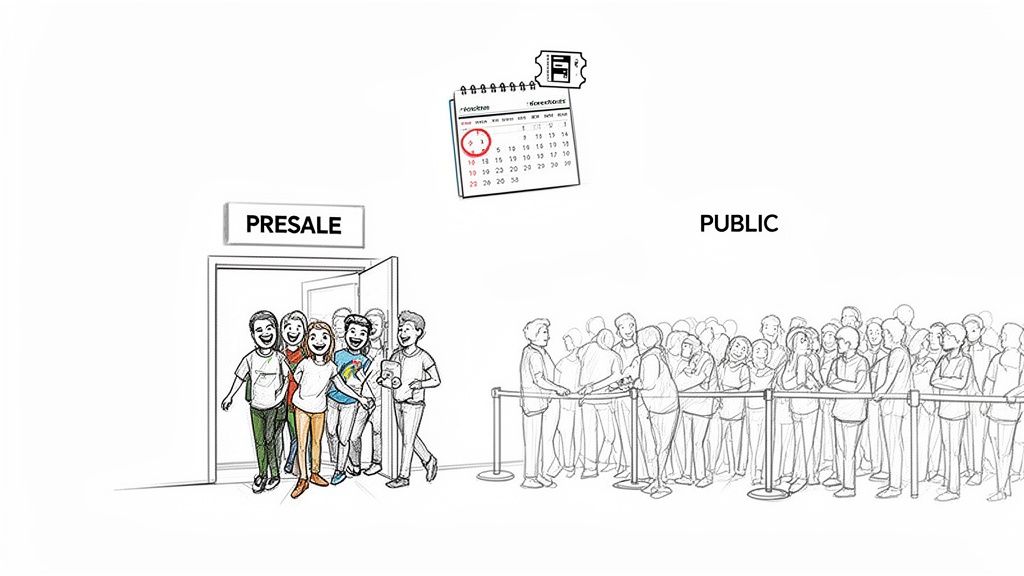
Think of it like this: a great local restaurant lets its regulars book a table for a special event before the phone lines open to the public. That’s a presale. You’re giving your most loyal fans a head start.
For a short time, a specific group gets a private link or a password to buy a small batch of tickets before everyone else.
So, What Exactly Is a Presale Ticket?
You’ve seen presales for massive stadium tours, but the same idea works for a 50-person pottery workshop, a pop-up dinner, or a local music showcase.
It’s a simple tool for anyone pouring their heart into an event. It's a way to give back to your most dedicated supporters.
Presale tickets are a big deal in the event world, which saw over 10.5 billion tickets sold in 2023 alone. A presale is just an early access window, often for 24 to 72 hours, where a slice of tickets is released to specific groups.
For you, this might mean opening up 20% to 40% of your seats a day early for past attendees or your newsletter subscribers. Simple. Effective.
How Does It Actually Work?
The process is refreshingly straightforward. As the host, you release a limited number of tickets to a handpicked group before your official on-sale date. This group could be your fan club, loyal customers on an email list, or followers on a specific social channel.
Here’s the basic flow:
The Announcement: You send a private message to your chosen group. It has a special link, a password, or instructions.
The Window: For a limited time, the presale is live. Only people with the password or link can buy tickets.
The Public Sale: After the presale closes, any leftover tickets go on sale to everyone.
This approach creates a sense of exclusivity and urgency. It makes your core audience feel seen, which is exactly the connection you want to build. You can take a deeper dive into what presale tickets mean for both sides.
For an event host, a presale is one of the best tools you have. It’s not just about selling tickets early. It’s about building a stronger connection with the people who believe in what you do.
Setting this up shouldn't be a technical nightmare. With the right platform, you can create a custom-branded ticket page in minutes. No code, no chaos. It's a simple way to give your best supporters first dibs, whether you're selling five tickets or five thousand.
Exploring Different Types Of Presales
Okay, a presale is an early access window. But "presale" isn't a one-size-fits-all term. There are a few different flavors.
Big arena tours have complicated presales with credit cards and streaming services. We can ignore those. They're mostly noise for independent creators.
Let's focus on the types that actually work for your workshop or supper club. The ones you can set up in minutes.
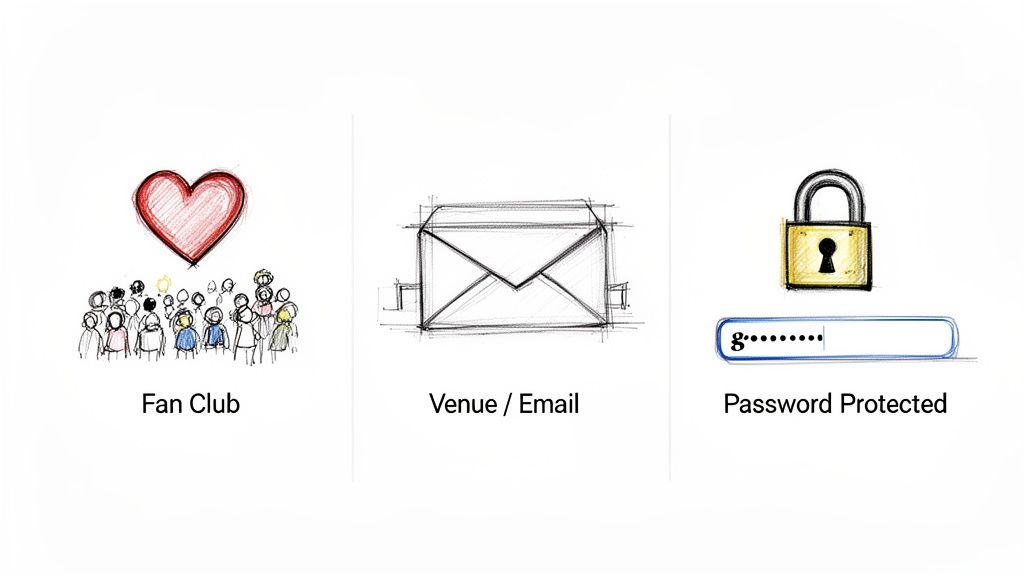
The Fan Club Or Community Presale
This is the classic. It's for your ride-or-dies. The people who showed up to your first event when you were still figuring things out.
You’re not just selling tickets; you’re rewarding loyalty.
A "fan club" can be as simple as your email list, your Patreon supporters, or students from a past course. You just send them a special link, and they get first crack at tickets.
- Example: A yoga instructor planning a weekend retreat emails everyone who attended her classes in the last six months. They get a 48-hour head start to book one of the 15 available spots.
The Venue Or Partner Presale
This one’s similar, but the audience comes from a partner. Let's say you're hosting a pop-up dinner at a local brewery. You could offer a presale to the brewery's newsletter subscribers.
It's a fantastic way to tap into a relevant audience. The brewery gets a cool perk for its regulars, and you sell tickets to people who already love the space. A true win-win.
- Example: A musician playing a show at a small coffee shop runs a presale for the shop’s loyalty program members. The shop promotes the show, and the artist fills seats with local fans.
The Password-Protected Presale
This method is less about who and more about how. It's the simplest and most flexible way to run a private sale.
You just put your ticket page behind a simple password.
Then, you share that password with whomever you want. Post it in a private Facebook group, send it in your newsletter, or tell people at another event. The password acts as a key, unlocking the ticket page only for those in the know.
This method gives you total control. It makes the presale feel like a little secret, which is a powerful way to build community.
Setting up a password-protected page sounds technical, but it’s not. With a platform built for real people, you can do it in minutes. You just type in a password and you're done. No code, no fuss.
All these methods reward your community and create early buzz. They aren't mutually exclusive, either. If you want another way to build early momentum, check out some strategies for using early bird tickets. The key is to pick the approach that feels most authentic to you.
Why Even Bother With a Presale?
It might seem like another task on your packed to-do list. But the real benefits go way beyond just selling a few tickets early. This isn't about creating "buzz" or other fluffy marketing words. It's about making smart, practical decisions.
Let's break down the three biggest advantages. They’re simple, powerful, and might make you wonder why you haven't run a presale before.
Reward Your Biggest Fans
First, a presale is a great way to say thank you to your most loyal supporters. These are the people who showed up to your first event and tell their friends about what you do.
Giving them first dibs makes them feel seen and valued. Like they're part of an inner circle.
This builds a powerful sense of community. Your core audience feels like insiders, which turns them from casual attendees into genuine advocates. That kind of loyalty is priceless.
A presale transforms a transaction into a relationship. You’re telling your community, "You were here first, so you get to go first."
Plus, people talk. When your biggest fans get early access, they often share their excitement online, creating authentic word-of-mouth marketing you simply can't buy.
Test Demand Without the Guesswork
Running an event can feel like you're just guessing. How many people will actually show up? Should you order more supplies?
A presale is your secret weapon against guesswork. Think of it as a real-world stress test for your event's demand.
By releasing a small batch of tickets early, you get instant, concrete data. Did they sell out in an hour? You’ve got a hit. Was the response slower? Maybe you need to tweak your marketing before the main sale. This early feedback is incredibly valuable.
Presales are used as demand-testing tools in a booming online ticketing market. A small-scale presale achieves the same goal. If you release 30% of your tickets and that block is 70% to 80% sold in hours, you have a clear signal. You can find more data on the online event ticketing market to see the broader trends.
- Example: A small festival organizer uses presale data to dial in logistics. If presale tickets move faster than expected, they know to book two extra food trucks. No long lines or unhappy guests.
This isn't just about avoiding problems. It's about optimizing for success. And it doesn't mean your presale tickets have to be cheaper. You can learn more by reading our guide on whether presale tickets are cheaper.
Create Urgency and Smooth Out Your On-Sale Day
Finally, a presale helps you manage the chaos of your main ticket launch. By creating a limited-time early window, you naturally build a sense of urgency.
When people see that a chunk of tickets has already been sold, it signals high demand. This encourages others to buy their tickets sooner. The fear of missing out (FOMO) is a real motivator.
This also smooths out the traffic on your on-sale day. Instead of a massive, chaotic rush, you’ve already handled a good portion of the sales. This reduces the strain on your ticketing page and creates a calmer launch.
With a simple platform, you can get this all set up in minutes. Your presale page can have custom branding to look like yours. With flat-fee pricing, you'll never see surprise percentage skims. It’s built for real people who need tools that just work.
How To Set Up Your First Presale
Alright, let's get practical. Enough theory. This is your straightforward guide to launching your first presale. The goal is to make this process feel totally manageable, even if you’re a team of one.
We’ll break it down into a simple timeline. No confusing jargon, just actionable steps.
Your One-Week Presale Timeline
A killer presale doesn't need months of planning. A week is plenty of time to get everything in order.
One Week Out: The Planning Stage
Define Your Audience: Who gets early access? Get specific. Is it everyone on your newsletter list? Only people who attended your last three events? Pinpoint the exact group.
Set Your Ticket Allocation: Decide how many tickets you'll release for the presale. A good starting point is between 20% and 40% of your total capacity. This leaves enough for the general sale.
Choose Your Price: Will presale tickets be the same price as general admission? A little cheaper? Maybe more expensive with a premium perk? Decide now. For more ideas, our guide on ticketing and sales strategies can help.
Three Days Out: The Setup Stage
Build Your Ticket Page: This is the technical part, and it should be easy. On a platform like ours, you can create a beautiful, custom-branded ticket page in minutes. No code needed.
Password-Protect Your Page: For a private presale, lock your page down. Choose a simple password (like
SUPPERCLUB24) that you can easily share with your audience.Draft Your Announcement Email: Write the email you’ll send to your presale group. Keep it short and clear. Tell them why they’re getting special access, state the exact presale start time, and include the password and link.
Launch Day: Go Time
Send the Email: At the scheduled time, hit send. Pro tip: do a final check that the link and password work one last time.
Monitor Early Sales: Keep an eye on how tickets are moving. This early data is gold. A flood of fast sales tells you demand is high.
As you get into the details, checking out some strategies for optimizing presale landing pages can help boost your sign-ups.
The technical setup should be the least of your worries. Your energy should go into creating the event, not fighting with software. A good tool just gets out of your way.
This whole process rewards your loyal fans, tests demand, and builds urgency.
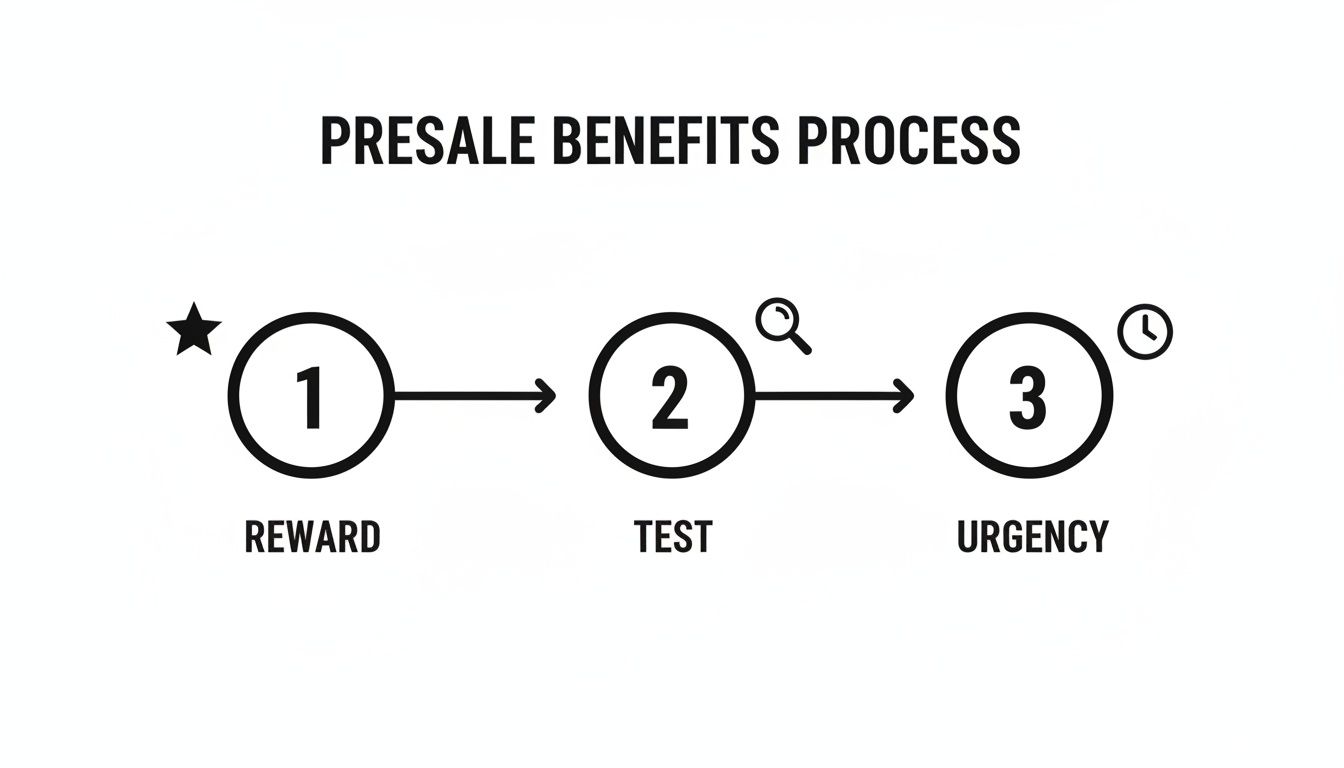
The flowchart above nails this three-step cycle, showing how each stage flows into the next.
To keep you on track, here's a simple checklist.
Your Presale Launch Checklist
This table breaks down the key steps from planning to launch day.
| Timeline | Task | Key Tip |
|---|---|---|
| 7 Days Before | Define Audience & Offer | Get super specific. "Newsletter subscribers" is good. "Subscribers who've bought before" is better. |
| 7 Days Before | Set Price & Allocation | Decide on a price and how many tickets to offer. Don't overcommit your inventory. |
| 3 Days Before | Build & Protect Ticket Page | Upload your event creative and set a memorable password. Test the page yourself. |
| 3 Days Before | Draft Announcement Email | Write a personal, compelling message. Make them feel like insiders. |
| Launch Day | Send Email & Monitor | Send the email right on time. Watch the sales come in to gauge initial demand. |
| Launch Day+1 | Consider a Reminder | If sales are slow, a "24 hours left" reminder can create a nice sense of urgency. |
Following these steps will help you run a smooth, stress-free presale every time.
Crafting The Perfect Presale Announcement
Your announcement email is critical. It’s an invitation to an exclusive club, not just a notification. Here’s a sample template you can adapt.
Subject: You're Invited: Early Access to [Your Event Name]!
Hi [Name],
Because you're one of our most valued supporters, we wanted to give you first access to tickets for our upcoming [Event Name] on [Date].
The presale starts on [Date] at [Time] and runs for just 48 hours.
Use this password to unlock your tickets: [YourPassword]
[Link to Your Ticket Page]
Thanks for being part of our community. Can’t wait to see you there!
Best,
[Your Name]
This template is direct, personal, and has all the essentials. Most importantly, it makes your supporters feel special.
Ultimately, setting up a presale is about building relationships. With the right tools, the process is simple. You can get a page live in minutes with your own branding and flat-fee pricing. You get fast, secure payouts straight to your account, so you can focus on what matters: pouring your heart into amazing events.
Common Presale Mistakes And How To Avoid Them
Alright, let's talk about what can go wrong. A few common tripwires can turn a smooth launch into a headache. The good news? They’re all easy to sidestep.
Think of it like cooking a new recipe. The first time, you follow the instructions. Once you know the ropes, you can improvise. These are the "don't substitute salt for sugar" rules of a presale.
Mistake 1: Getting Your Ticket Allocation Wrong
This is the classic Goldilocks problem. You either offer too many tickets or not enough.
If you allocate too many (say, 80% of capacity), you risk a weak public sale. This can make your event look less popular than it is and kills the urgency.
If you allocate too few (like 5%), your loyal fans will miss out. The presale sells out in a flash, but it can leave your biggest supporters feeling frustrated.
The Fix: Stick to the sweet spot. A presale allocation of 20% to 40% of your total tickets is a solid benchmark. It’s enough to feel exclusive but leaves plenty for a buzzy public launch.
Mistake 2: The Never-Ending Presale Window
Urgency is your best friend. A presale that drags on for a week loses all its power. People think, "I'll get to it later," and then forget. A long window doesn't feel special.
You want to create a short, focused burst of activity. The presale should feel like a limited-time opportunity because it is.
The Fix: Keep your presale window short. Twenty-four to 48 hours is perfect. This creates a clear deadline and encourages people to act now. A "24 hours left!" reminder email can work wonders.
Mistake 3: Ignoring The Reseller Problem
Even for smaller events, ticket resellers can be a nuisance. They scoop up tickets to flip for a profit, leaving your actual fans empty-handed.
This is fueled by a secondary ticket market valued at around $2.85 billion in 2023. While your pop-up dinner isn't a stadium tour, the same principles apply. You can see the full market analysis on Straits Research for a deeper dive.
The Fix: Fight back with a few simple limits. First, cap the number of tickets one person can buy—four to six is a common limit. Second, use a unique link or password. This makes it much harder for bots to find your ticket page.
A presale aimed at a known list of past customers is your best defense. You’re not selling to strangers; you’re selling to people who genuinely want to be there.
Mistake 4: Sending A Confusing Announcement
Your announcement email has one job: get people to the ticket page, password in hand, ready to buy. A vague, cluttered email will just confuse them.
If your instructions aren't clear, people will get frustrated. You'll get a flood of emails asking for help instead of a flood of sales notifications.
The Fix: Be ruthlessly clear. Your email only needs five things:
A clear subject line (e.g., "Your Early Access Inside")
The exact start and end time of the presale
The direct link to the ticket page
The password in bold text
A short, personal note explaining why they get access
That’s it. No fluff. A simple platform lets you create a custom-branded page and handles secure payouts, so you can focus on your community.
Got Questions About Presales? We've Got Answers.
We’ve covered a lot. By now, you should have a solid handle on what presales are and why they’re so powerful.
Let’s finish by tackling a few of the most common questions we hear.
How Many Tickets Should I Put in a Presale?
The sweet spot is between 20% and 40% of your total ticket inventory.
This is enough to feel exclusive and gives you meaningful early sales data. But it still leaves plenty of tickets for the general sale, so you get that second wave of buzz.
Go over 50%, and your main launch can feel a bit lackluster. Dip below 20%, and your most dedicated fans might feel like they barely had a shot.
How Long Should a Presale Run?
Urgency is key. A long presale is a momentum killer. People see the announcement, think, "I'll get to that later," and then forget.
Keep it short and punchy. Twenty-four to 48 hours is perfect.
That window is just long enough for people to see your email and act, but short enough to create a real deadline. A simple "12 hours left!" reminder email works wonders for a final sales push.
What if My Presale Tickets Don't Sell Out?
First, don't panic. It happens. A presale that doesn’t sell out isn't a failure—it's data.
You just got valuable feedback before going public. Maybe your price point was a little high. Perhaps the email wasn’t compelling enough. Or maybe demand is just a little softer than you predicted.
A presale that doesn't sell out is just free market research. It tells you what you need to adjust for the main event.
This is your chance to pivot. You can tweak your marketing message or reconsider pricing before the public sale. It’s better to learn this with a small batch of tickets than with your entire inventory.
Should Presale Tickets Be Cheaper?
They don’t have to be. While a small discount can be a nice perk, the main draw for a presale is early access, not a bargain. Exclusivity is the real reward.
Here are three ways to handle pricing:
Same Price: Tickets are offered at the standard price. The only benefit is getting them before they’re gone. This is the simplest approach.
Early-Bird Discount: You could offer a small discount, say 10% to 15% off, as an extra thank you. This can help drive faster sales.
Premium Price: Yep, you can actually charge more. If your presale tickets come with something extra, like a free drink or preferred seating, it justifies a higher price.
The right call depends on your event and what your audience values. Don't just assume you need to offer a discount.
How Do I Keep My Presale Link From Spreading?
You want your presale to feel special, but it's the internet—links and passwords get shared. You can’t stop it completely, but you can minimize it.
First, use a simple password-protected page. This step adds enough friction to stop most casual sharing.
Next, frame it correctly in your announcement. A simple line like, "This is an exclusive offer just for our mailing list," creates social pressure that goes a long way.
Finally, set a reasonable ticket limit per order. Capping purchases at four to six tickets is a great way to prevent one person from buying up your entire presale stock to resell them.
Getting this set up shouldn't be a nightmare. With a platform like Ticketsmith, you can have a custom-branded, password-protected page running in minutes. You get simple, flat-fee pricing and fast payouts right to your account. It's built for real people, whether you're selling five tickets or five thousand.