
Great ticketing is invisible. When it works, nobody notices. But when it goes wrong? It’s all anyone remembers about your festival.
Film festival ticketing is way more than just selling a ticket. It’s the whole process of getting people in the door. From setting prices and managing screening caps to running check-in and making sense of sales data.
The Unseen Work of Film Festival Ticketing
Selling tickets seems simple. You pick a price, people click "buy," and they show up. Done.
Then reality crashes the party. Suddenly you’re juggling single-screening tickets, VIP passes, student discounts, and a block of seats for your main sponsor. What started as a simple task is now a monstrous spreadsheet.
This guide is for the indie organizers and the community cinema heroes. It’s for everyone pouring their heart into bringing a festival to life. We’re cutting the jargon to give you a practical playbook.
Why Your Ticketing Setup Is a Big Deal
Nobody leaves a film festival raving about the ticketing process. But you can bet they’ll skip next year if it was a nightmare. A clunky system creates friction. Friction is the enemy of a good event.
Your goal is to make it all seamless. So seamless, attendees barely think about it. It should just work.
This is where the right platform is a game-changer. You shouldn't need a developer just to get a ticketing page online. It should take minutes. You can create a branded page that looks like your festival, not a generic template.
Whether you're selling five tickets for a workshop or five thousand passes for a week-long fest, the principles are the same. Mastering this is one of the most critical event management skills you can build.
A great film festival ticketing setup does three things well: It makes it easy for people to give you money. It gives you clear data on who is coming. And it gets out of the way so people can enjoy the films.
Structuring Your Tickets, Passes, and Prices
Getting your pricing right is a big hurdle. Nail it, and you turn lookers into buyers. Get it wrong, and you leave money on the table or confuse people until they close the tab.
Let’s build your offerings simply. You don’t need a dizzying spreadsheet with fifty ticket types. The goal is real choice without decision paralysis.
Start with the Building Blocks
The foundation of any good film festival ticketing strategy rests on a few key types.
Single Screening Tickets: The most straightforward option. One ticket, one film. Perfect for the casual moviegoer.
Day Passes: Ideal for folks who want to dedicate a full Saturday to your festival. They get access to all regular screenings for a single day.
Full Festival Passes: This is for the die-hards. It grants access to everything for the entire festival run.
VIP Packages: The premium experience. This usually bundles a full pass with perks like reserved seating or exclusive filmmaker Q&As.
Deciding on these options is your first step. You can dive deeper into the pros and cons of different types of ticketing models in our guide to see what fits your festival.
Smart Pricing That Sells
Once you've sorted your ticket types, it's time to price them. This isn’t just about covering costs. It’s about creating value and a little urgency.
A simple, powerful strategy is to make your passes an obvious deal. If a single ticket is $15, a day pass for four films should be less than $60. Maybe $45. This simple math encourages people to commit to a full day. The same logic applies to the full festival pass.
Don't overcomplicate it. Your pricing should tell a clear story: the more you commit, the more you save. It’s a simple thank you for their support.
Another fantastic tool is the early bird discount. Launching ticket sales with a 15-20% discount for the first few weeks is a proven way to build momentum. It rewards your biggest fans and helps generate crucial early revenue.
For example, a festival might price its full pass at $200 but offer it for $160 for the first two weeks. This creates a real reason for people to buy now instead of later.
Creative Bundles and Tiers
Beyond the basics, you can get creative. Bundles are great for attracting specific audiences.
Consider a simple "Date Night" package. Two tickets to an evening screening plus a voucher for popcorn. It's a small touch that frames your festival as a great social outing.
Targeted tiers also work wonders. A Student Pass at a big discount makes your festival accessible to a younger, budget-conscious audience. Just be sure your ticketing system can handle different price points without giving you a headache.
As you set these up, collecting payments has to be smooth. You can learn how to effectively add payment options to your registration forms to streamline this process.
Keeping It All Manageable
The complexity can grow fast. A small festival with just a handful of films can quickly hit logistical snags. A huge event like the Berlin International Film Festival (Berlinale) manages 329,502 tickets across 884 screenings.
Your scale might be different, but the core problem is the same. You need a system that can handle it all without breaking a sweat.
This is where your ticketing platform is critical. You need something you can set up in minutes, not days. It should let you create ticket types, apply discounts, and manage capacities without writing code.
My best advice? Look for a platform with flat-fee pricing. Predictability is your friend. Knowing you'll pay a small, fixed amount per ticket means no nasty surprises. You get fast, secure payouts straight to your account so you can focus on the films.
Mapping Your Screenings and Capacities
Your festival schedule is its lifeblood. Every screening is its own unique event with its own capacity. Get this wrong, and you’re either overselling your hottest ticket or staring at an empty theater.
The goal is a single source of truth. When a screening time changes (and it always does), you need to edit it once. That update should ripple across your website, ticketing page, and internal docs instantly.
Building Your Schedule Digitally
Think of each screening as its own mini-event. Even if it's the same film, a different time or venue makes it a separate entry in your ticketing system.
Here’s what that looks like in the real world:
Screening 1: The Midnight Rider - Friday, 7:00 PM - Cinema One (Capacity: 150)
Screening 2: The Midnight Rider - Saturday, 3:00 PM - The Black Box (Capacity: 75)
Screening 3: Sunrise Valley - Saturday, 8:00 PM - Cinema One (Capacity: 150)
Each entry must have its own unique capacity tied to it. This is non-negotiable. A good platform automatically cuts off sales when a screening is full. This simple feature prevents the nightmare of turning away angry ticket holders.
And setting up your ticketing page shouldn't require a web developer. With the right tools, you can build this entire schedule in minutes, with a clean look that feels like your festival.
Handling Holds and Reserved Seats
What about seats for the press, the film's crew, or that big sponsor? Manually blocking off seats for every event is a tedious chore that will drive you nuts.
A smart film festival ticketing system lets you create "holds" automatically.
You should be able to say, "Reserve 20 seats for every screening at Cinema One for our sponsors," and have the system do the work. This saves hours and ensures you never accidentally sell a seat promised to a VIP.
These holds can then be released closer to the event date. Either by hand or on a schedule. This puts those seats back in the general pool if they go unclaimed.
Things get trickier with assigned seating. For that, you'll need a system that handles seat maps. We put together a guide on the nuts and bolts of creating a seating chart that can help.
This flow chart shows how different ticket types all pull from your screening inventory.
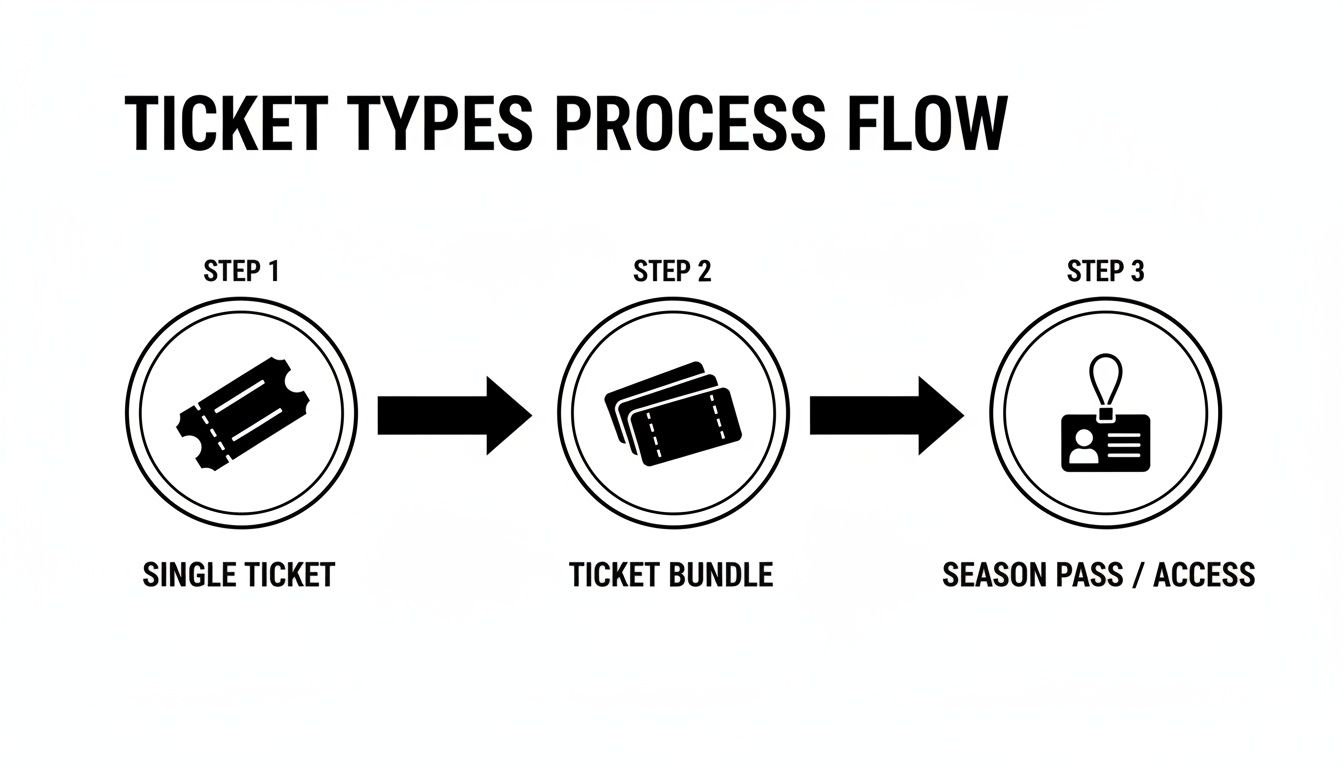
Whether it’s a single ticket or a pass for multiple screenings, each purchase has to draw from the correct capacity. No exceptions.
The Power of a Centralized System
The magic happens when your schedule, capacities, and sales all live in one place. You get a real-time dashboard of your festival's health. You can see which films are selling out and which need a promotional push.
When organizers use disconnected tools, things break. Info gets outdated and you spend more time fixing problems than running a great event.
A unified platform built for real people means you can manage everything without the chaos. You get fast, secure payouts and transparent, flat-fee pricing. Whether you’re hosting five people or five thousand, your focus should be on the films, not on wrestling with clunky software.
Your On-Sale Strategy and Audience Communication
You’ve priced your tickets and mapped the screenings. Now for the main event: selling them. When do you hit “go”? And how do you make sure people are ready to click “buy”?
Your on-sale strategy is more than picking a date. It’s about building momentum. A well-timed, clear launch can be the difference between a slow trickle of sales and a sold-out success.
Phased Rollouts Build Buzz
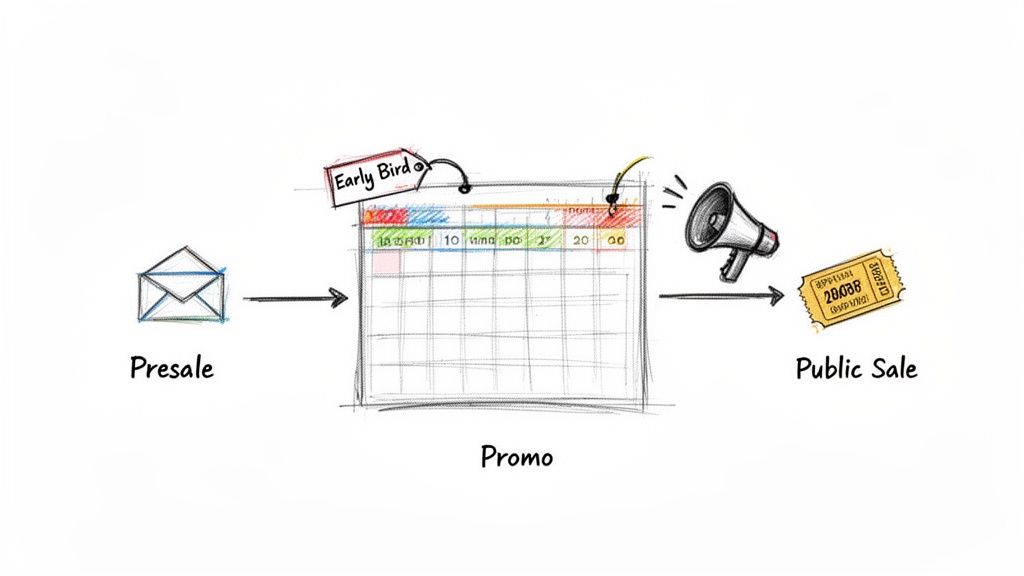
Dumping all your tickets on sale at once is simple, but rarely smart. A phased approach generates excitement and rewards your biggest supporters.
Think about rolling it out in tiers:
Members-Only Pre-Sale: Give your loyal members or donors a one-week head start. This is a real perk that makes their support feel valued.
Newsletter Subscriber Access: Next, open sales to your email list. These are people who are already interested. Give them a nod for being in the loop.
Public On-Sale: Finally, open the floodgates. By now, you’ve built buzz. Some screenings might even be close to selling out, which lights a fire under procrastinators.
This tiered method isn't just for giants like Sundance. Even a small, local festival can use this exact playbook to build a loyal following and lock in early cash.
Your Ticketing Page Is Your Storefront
The moment someone decides to buy a ticket, they’re in your digital box office. What does it look like? Does it feel like your festival, or a generic, third-party page?
This is a bigger deal than most organizers realize. A professional, custom-branded ticketing page builds trust. Your audience should see your logos, your colors, your fonts. It’s a seamless experience that shows you care.
Don't let a clunky, off-brand checkout page be the final impression you make. The purchase flow is part of the festival experience. Make it a good one.
Your best friend here is a platform that lets you set this up in minutes, no code needed. It should look like you hired a designer, even if you just uploaded your logo.
Clear Communication Is Everything
Your audience shouldn't have to play detective to buy tickets. Your website, social media, and emails need to be painfully clear about what’s for sale and when.
Don't bury the "Buy Tickets" button. Make it big and obvious. And please, use simple language. Instead of "Purchase Admission," just say "Get Tickets."
The communication can’t stop after the purchase. A great film festival ticketing system will instantly send a confirmation email. This email is your front line of customer service. It must contain:
The attendee’s name
The exact screening, date, and time
The venue address
A scannable QR code
A link to your festival’s FAQ page
This one email answers 90% of questions and drastically cuts down on frantic messages on opening night. To nail the financial side, it's worth tapping into some payment processing expertise as you build your strategy.
Your platform should handle all this gracefully. Fast, secure payouts and a simple flat fee per ticket mean no surprise bills. You just get paid for the amazing event you've built.
On-Site Box Office and Check-In Workflows
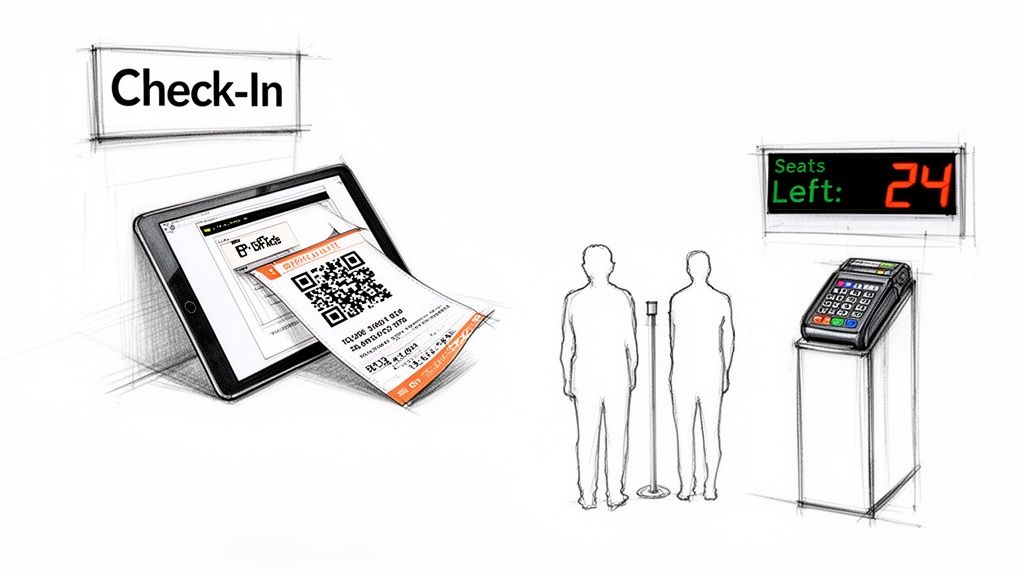
The big day is here. It all comes down to getting people through the door without a chaotic mess. The check-in process sets the tone for the entire screening. A fast, friendly welcome makes people happy. A long line makes them grumpy.
Your goal is to eliminate lines and stress. This is where your ticketing system has to shine on the ground. A smooth workflow is your best defense against opening-night chaos.
The Modern Box Office Is in Your Pocket
Forget bulky laptops or special scanners. Your box office hardware is already in your volunteers' pockets.
Modern check-in apps work on any standard smartphone or tablet. Your team can be mobile, scanning tickets from multiple entry points to keep lines moving.
The best on-site box office is one you can set up in five minutes. One tablet for selling door tickets, a couple of phones for scanning, and a reliable Wi-Fi connection. That's it. You're in business.
This lightweight approach saves money on rentals and makes your setup flexible. If a huge crowd forms at one door, you can instantly deploy another volunteer with their phone to open a new line.
Nailing the Digital Check-In
The core of a fast check-in is the QR code. Every ticket email should have a big, obvious code attendees can pull up on their phones. Your job is to make scanning it simple.
Here's a field-tested process that just works:
Greet and Scan: One volunteer greets the attendee while another has the scanner app ready. A quick scan of the QR code should instantly pull up the ticket details.
Verify and Confirm: The app flashes a green checkmark for a valid ticket or a red X if it's already been used. A quick "Enjoy the film!" and they're on their way.
Handle the Exceptions: Someone forgot their ticket or their phone died? It happens. A good system lets you look them up by name or email in seconds, check them in manually, and keep the line moving.
This whole interaction should take less than ten seconds per person. The secret is a system that syncs in real-time. A ticket scanned at one door is immediately marked "used" for all other scanners. A simple barcode for tickets can prevent duplicate entries and keep your headcount accurate.
Selling Tickets at the Door
Even with a great pre-sale campaign, you'll always have walk-ups. Your on-site system needs to handle these sales smoothly, which means accepting both cash and card payments.
Your ticketing platform should let a volunteer sell a ticket on a tablet and process a card payment. That ticket must immediately count toward the venue's capacity. Real-time inventory updates are non-negotiable. The last thing you want is your box office selling a ticket to a screening that sold out online two minutes ago.
This simplicity is vital for attracting new audiences. The BFI London Film Festival saw a massive 47% of tickets sold to first-time attendees. A low-friction process is essential for converting curious newcomers into happy festival-goers who come back next year.
Juggling Passes, Accreditation, and Special Access
A film festival isn't just for the public. You’ve got a whole other cast of characters to manage: filmmakers, press, judges, and sponsors. They all need special access. Figuring that out is a classic festival-organizer headache.
This isn't just about handing out freebies. It’s about a professional experience for the people who give your festival its credibility. The last thing you want is a director stuck in line or a sponsor turned away from the VIP lounge.
Different People, Different Permissions
Stop thinking about tickets. Start thinking in terms of “attendee types.” Your ticketing platform should let you create distinct categories, each with its own set of rules.
For example, you could set up:
A Filmmaker Pass: Grants free access to all regular screenings and maybe the opening night party. It’s a simple gesture of respect.
A Press Pass: This can be more targeted, giving access to specific press screenings and Q&As.
An All-Access VIP Pass: Reserved for top-tier sponsors or judges, this pass unlocks everything.
The beauty is that a single QR code on a badge can hold all this information. When a volunteer scans a pass, the system instantly knows who that person is and what they’re allowed into. No confusion. No awkward conversations.
Don't treat your VIPs like an afterthought. A system that can distinguish between a paying customer and an accredited guest at check-in is a small detail that screams "well-run, professional event."
Taming Promo Codes and Group Sales
Beyond formal accreditation, you’ll need a smart way to handle discounts and comps. How do you give your sponsor 50 free tickets? Or offer a 20% discount to the local film club?
This is where promo codes come in. A good platform lets you generate unique, trackable codes for different partners. This is huge. You can create a code for a partner and see exactly how many people used it. That data is gold for measuring your outreach.
For instance, the Miami Jewish Film Festival grew to over 58,000 attendees by creating targeted programs. It’s a perfect example of how specific passes and discounts can expand your reach.
It’s all about control and simplicity. Setting up these special passes shouldn’t require a computer science degree. You should be able to spin them up in minutes with a system built for real people—no hidden percentage fees, just fast payouts and tools that work.
Common Questions from the Festival Trenches
Alright, you're deep in the weeds of planning. I'll bet a few key questions are rattling around in your head. Let's tackle the big ones.
What’s the Right Way to Price Our Tickets?
There's no magic number, but there is a smart process. First, do the unglamorous math. Figure out your baseline cost for each screening. Venue rental, staff pay, film rental fees. That’s your break-even point.
Next, do some local recon. See what other festivals or cinemas in your area charge. You just want a feel for the local market so you don't price yourself into outer space.
The best approach is almost always a tiered structure.
Single Tickets: Your baseline price.
Day Passes: Offer a clear discount for buying a full day's worth of films.
Full Festival Pass: This should be the absolute best value for your die-hard fans.
And one more pro tip: always launch with an early bird discount for the first few weeks. It’s the best way to create initial buzz and cash flow.
How Should We Handle Sold-Out Screenings and Waitlists?
First rule of sold-out shows: don't oversell. Ever. Let your ticketing platform be the bad guy. It should automatically cap sales the second you hit capacity. This will save you from fire marshals and furious patrons.
For hot-ticket films, set up a digital waitlist. When a sponsor releases their held tickets or someone cancels, you can offer those seats to people on the list. It’s organized, fair, and better than a chaotic standby line.
The goal is to turn disappointment into a positive experience. A waitlist tells fans, "We see you, and we'll let you know if a spot opens up." It keeps them engaged.
Should We Absorb Ticketing Fees or Pass Them On?
Ah, the age-old debate. My take? If you're using a platform with a low, flat fee, just build it into the price.
Think about it from the buyer's side. Nothing kills excitement like a surprise "service fee" on the final checkout page. It feels sneaky.
For a $15 ticket, it's one thing. But for a $150 pass? Absorbing a tiny flat fee is a simple customer service win. It signals transparency and respect for your audience. That pays off in loyalty.