
Let’s Get Your Event Sold Out
So you’ve done the hard work of planning an amazing experience. But now comes the part that feels daunting: actually selling the tickets. Setting up a sales page, figuring out payments, and marketing can feel overly complicated.
It doesn’t have to be.
This is a guide for the creators, the makers, and the local organizers. I'm going to walk you through getting a simple, beautiful event page live in minutes. Zero code required.
Your Event, Your Brand
The goal is a seamless experience for your attendees. When they click to buy a ticket, they should feel like they're still in your world. They should see your branding, logo, and voice.
It’s a small detail that builds a ton of trust. It makes your intimate pop-up feel just as professional as a massive festival.
You’re not just selling a ticket; you’re inviting someone into an experience you created. The sales page is the front door. It should feel like you.
This is all about running your event, your way. That means finding a tool that gets behind your vision, not one that plasters its own ads all over your page.
Forget Hidden Fees and Slow Payouts
One of the biggest headaches for small event hosts is unpredictable costs. So many platforms draw you in with a "free" setup, only to skim a percentage off every single ticket. That fee eats directly into your profit.
Look for a simpler approach:
Flat fee pricing: You should know exactly what you’ll pay per ticket, whether you sell five or five thousand. No surprises.
Fast, secure payouts: The money from your ticket sales should go straight to your bank account. It shouldn't sit in a third-party wallet for weeks.
Simple setup: You have an event to run. You don’t have time to wrestle with clunky software.
Selling out is only half the battle. We've got more tips on how to increase event attendance that go beyond the ticketing page. This guide is about making sure you succeed from the first ticket sold to the final applause.
Pricing Your Tickets and Planning Your Event
Before you can sell a single ticket, you need a plan. Let’s talk numbers. Don't worry, this isn't about complex spreadsheets. It's about making sure you get paid fairly for the experience you're creating.
First, get a real handle on your costs. This is the only way to find your break-even point—the minimum you need to make just to cover expenses. Anything above that is profit.
Tally Up Your Costs
Start by listing every single thing you have to pay for. Be brutally honest. The small stuff adds up faster than you’d think, so don’t leave anything out.
Your list of expenses might look like this:
Venue Rental: The fee for the space.
Supplies & Materials: Clay for a workshop. Ingredients for a dinner.
Marketing: Did you pay for an ad? Hire a designer? Write it down.
Your Time: This one is huge and often overlooked. You have to pay yourself. Decide on an hourly rate for all your planning and hosting time, and add it to the list. You are not a volunteer at your own business.
Here’s a straightforward breakdown to help you figure out a smart ticket price.
Example Budget for a Small Workshop
Let’s imagine a small pottery workshop for ten people.
| Expense | Estimated Cost | Notes |
|---|---|---|
| Studio Rental (4 hours) | $200 | Includes kiln firing. |
| Clay & Glaze | $100 | $10 per person. |
| Tools & Supplies | $50 | Brushes, sponges, aprons. |
| Marketing (Social Ads) | $50 | A small, targeted campaign. |
| Your Time (10 hours) | $250 | At a modest $25/hour. |
| Total Costs | $650 | Your break-even point. |
In this scenario, your total cost is $650. To break even with ten attendees, each ticket must be at least $65. If you want to make a profit of, say, $350, you need to bring in $1,000 total. That means each ticket needs to be priced at $100.
Knowing these numbers gives you confidence. It turns pricing from a wild guess into a simple calculation.
Setting Your Ticket Price
Okay, now that you know your costs, you can decide what to charge. Pricing is part art, part science. You need a price that covers your expenses, pays you for your work, and feels valuable to your attendees.
Don’t just pluck a number out of thin air. Think about the value you're providing. A three-course meal cooked by a local chef is worth more than a simple cooking demo.
Your ticket price sends a message. Don't be afraid to charge what your event is worth. Underpricing is one of the most common mistakes new organizers make.
Consider creating a few different ticket types. This isn't just for giant festivals; it works wonders for small events, too.
Early-Bird Tickets: This is a classic for a reason. Offering a small discount for the first wave of buyers creates urgency. We've seen hosts have great success with this, and you can learn more about crafting the perfect early-bird ticket strategy to build that initial buzz.
Standard Admission: Your main ticket price. This is what most people will pay.
VIP or Premium Tier: Offer something extra for a higher price. For a pop-up dinner, it might be a welcome cocktail. For a workshop, it could be a take-home kit with premium supplies.
For example, a pop-up chef hosting a 20-person dinner calculated her food cost at $30 per person. Her other costs brought her break-even point to $1,200, or $60 per ticket. She set her standard ticket at $85 to ensure a healthy profit.
Then, she added two other options: five early-bird tickets at $75 and three "Chef's Table" tickets at $115. The result? She sold out quickly and increased her overall revenue.
The key is to give people options. With a simple ticketing tool, you can set these tiers up in just a few minutes, no coding needed.
Choosing the Right Online Ticketing Tool
This is where so many small creators get stuck. You search online to sell tickets for an event, and suddenly you’re drowning in options. Most are built for massive festivals, not your intimate pop-up dinner.
They often lure you in with a “free” setup, but that’s rarely the whole story. Let’s cut through the noise and figure out what actually matters for someone like you.
What to Look For (and What to Avoid)
The right tool should feel like an extension of your brand, not some clunky third-party portal. It’s the difference between a professional experience and one that feels a little sketchy.
Here's the checklist that really matters:
Custom Branding: Your event page needs your logo and your colors. It’s your event, and the page should look like it.
Simple Setup: You should be able to get a beautiful page live in minutes without calling a developer. No code required. Ever.
Transparent Pricing: This is the big one. Avoid platforms that are cagey about their fees.
That last point about pricing is the most critical. It directly impacts how much money you take home.
Flat Fees vs. Percentage Skims
Most platforms make their money in one of two ways. The most common is the percentage-based model, where they take a cut of every ticket sold. This model literally penalizes you for being successful. The more you sell, the more they take.
A simpler, fairer approach is a flat fee. You pay a predictable, small amount per ticket. Whether you sell ten tickets for a workshop or a thousand for a community fair, the cost per ticket stays the same. You can easily factor it into your pricing. No nasty surprises.
Your ticketing platform should be a simple utility that helps you succeed, not a partner that takes an ever-growing slice of your revenue.
Focusing on your own numbers makes the decision so much clearer. This flowchart shows a simple path from calculating your break-even point to landing on a final ticket price.
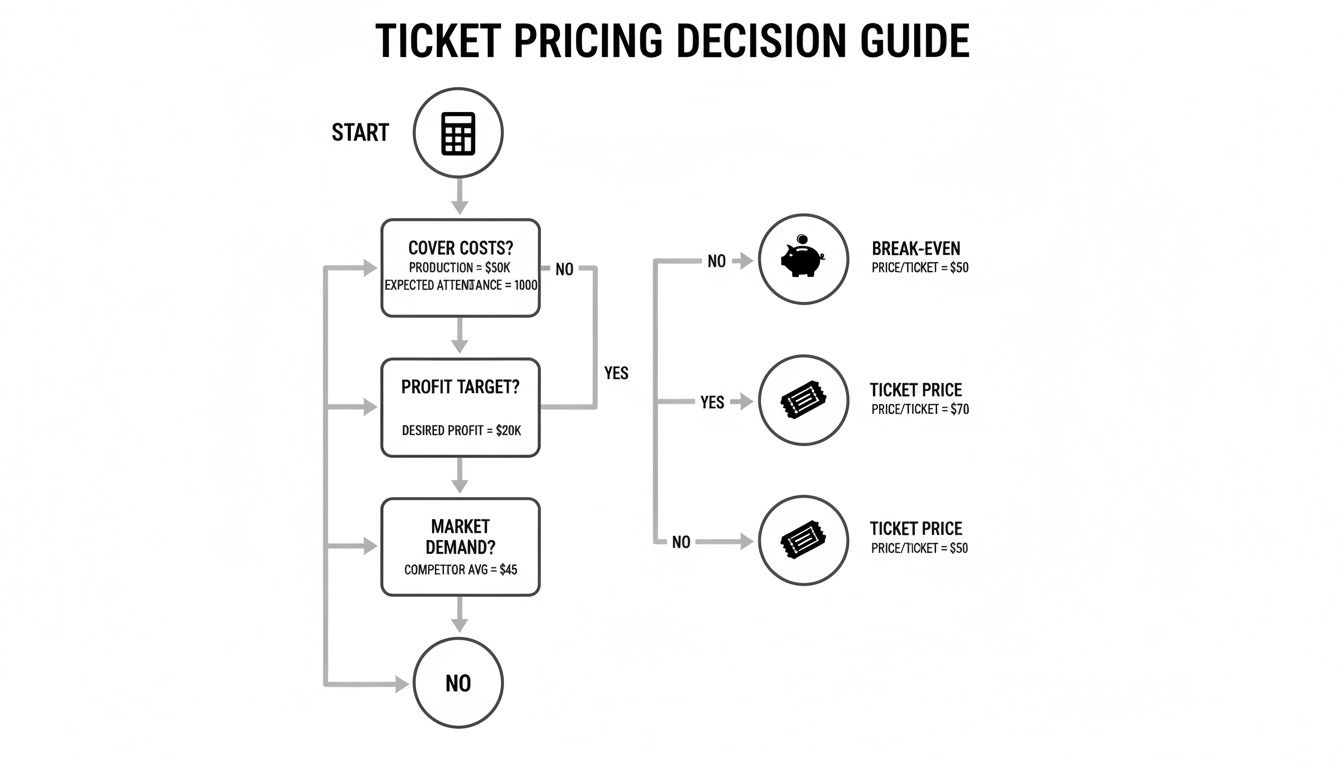
When you understand your bottom line first, choosing the right tool and its fee structure becomes way less intimidating.
Your Sales Page Is Your Digital Venue
When you pick a ticketing tool, you're also choosing the platform for your event's landing page. Think of this page as your digital storefront. It needs to be clean, convincing, and dead simple to use.
The Online Event Ticket Sales industry in the U.S. is projected to hit $12.5 billion by 2025. That surge is driven by people who need simple, mobile-first solutions to get their events live and selling fast.
A good platform gives you the bones for a great sales page. It lets you add compelling images, clear descriptions, and an unmissable "Buy Tickets" button. It's worth learning more about creating a high-converting landing page to make sure your page turns visitors into attendees.
We wrote a detailed comparison of what we believe is the best https://ticketsmith.co/blog/best-ticketing-platform-for-events. It’s designed to help you find a tool that works for you, gets your money into your bank account securely, and doesn't punish you for selling out.
Marketing Your Event and Selling Tickets
So your ticket page is live. It’s looking sharp, the pricing feels right, and you're ready for sales to roll in. Now what? Now, we get people to actually click "buy".
Throwing a single post up on Instagram and crossing your fingers isn't a strategy. It's wishful thinking. The good news is, you don't need to be a marketer to sell out your event. You just need a simple plan.
Let's build one right now.
Start With a Killer Event Description
This is your single most important piece of marketing. Your event description is your sales pitch, your story, and your instruction manual all in one. Don't rush this part.
Your goal is to answer a few key questions with clarity:
What is it? A hands-on sourdough workshop, a five-course pop-up dinner, etc.
Who is it for? Beginner bakers, adventurous foodies, people tired of Netflix.
What will they get out of it? They'll leave with their own loaf of bread, taste unique ingredients, or learn a new skill.
When and where is it? The date, time, address, and any key details like parking.
Why should they book now? Limited spots available. Early-bird pricing ends this Friday.
That last point is the kicker. Creating a little urgency isn't pushy; it's a gentle nudge. We're all busy. A simple line like "Only 12 spots available" can be the difference between a "maybe later" and a "just booked!"
Use the Audience You Already Have
Your first ticket buyers will almost always come from your inner circle. The people who already know and trust you. Your job is to make it easy for them to buy and share.
Start with your email list. Even if it’s just 50 people, that’s 50 people who chose to hear from you. Send them a direct, personal email announcing the event. Tell them why you’re excited and drop in a direct link to the ticket page.
Don’t overthink it. A simple, honest message is always best.
"Hey friends, I'm so excited to announce I'm hosting another pop-up dinner next month! There are only 20 seats available. You're the first to know. You can grab your spot here before I share it publicly."
That’s it. No fancy graphics needed. Just a clear message and an easy link.
The Power of Personal Outreach
Never underestimate the impact of a direct message. A generic social post is like shouting into a crowded room. A DM is like tapping someone on the shoulder and having a conversation.
Think of five to ten people who would genuinely love your event. Send them a personal message. Not a copy-and-paste spam blast, but a real note.
Something like, "Hey Sarah, I remembered you said you wanted to learn more about natural wine. I'm hosting a small tasting next month and immediately thought of you. No pressure, but here’s the link if you want to check it out."
This approach feels personal and respectful. It often works better than a slick ad campaign because it’s built on a real connection.
Team Up with Others
You don't have to do all the marketing heavy lifting alone. Find other local creators or businesses whose audience overlaps with yours and see how you can help each other.
Hosting a fitness class? Partner with a local juice bar for a post-workout discount.
Running a pop-up dinner? Team up with the ceramicist who made your plates for cross-promotion.
Organizing a small music show? Ask the opening band to share the ticket link with their followers.
This isn’t about big, formal partnerships. It's about finding friendly allies. A simple Instagram story share from the right person can lead to a burst of sales.
Your marketing needs compelling calls to action. A strong CTA removes guesswork and tells people exactly what to do next. For some great ideas, check out these high-converting call to action examples.
I know a local band that sold out their show by creating a simple, shareable poster for Instagram stories. They sent it to ten friends and just asked them to post it. That single act created a ripple effect that filled the venue. Your marketing doesn’t need a huge budget. It just needs a little heart.
Managing Your Event From Check-In to Follow-Up
You did it. The tickets are sold and your event is officially sold out. Now for the fun part—actually running the thing.
Let's talk about managing the day-of without chaos. A fantastic experience begins the second your guests arrive. The last thing you want is a clunky check-in, with people fumbling for confirmations while a line snakes out the door.
This is where a little tech makes a world of difference.
Making Check-In Effortless
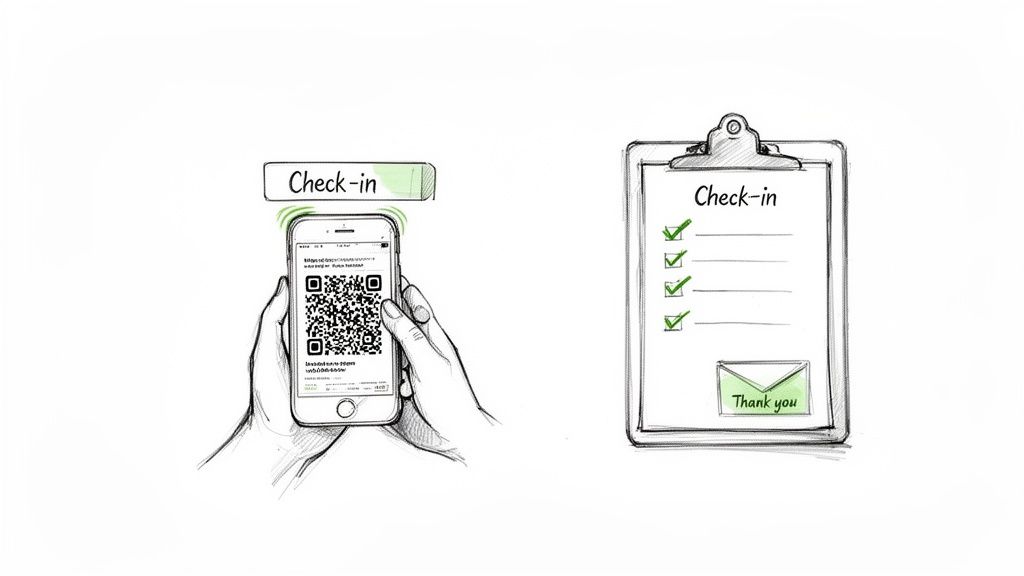
The goal is a welcome that feels personal and efficient, not like airport security. Forget spreadsheets and printed lists. A modern ticketing tool should handle this for you.
Your attendees will have a ticket with a unique QR code on their phone. All you (or a helper) need is a smartphone to scan it. It's fast, simple, and instantly confirms who has arrived.
This approach brings a few huge benefits:
It’s fast. A quick scan is all it takes. This keeps the line moving.
It’s secure. Each code is unique, so you don’t have to worry about duplicate tickets.
It’s simple. No special hardware is required. Just an app on your phone.
Using a system like this makes you look incredibly professional, even if you’re a one-person show. For a deeper dive, our guide on how to use a barcode for tickets explains exactly how this straightforward tech works.
Handling On-the-Spot Questions
No matter how you plan, people will have questions. "Where's the restroom?" "Is there parking nearby?"
Have a designated person ready to field these queries. Better yet, include a small FAQ in the final reminder email you send the day before the event. A little proactive communication can save you a lot of repetitive conversations.
Your job on event day is to be a host, not just an operator. A smooth check-in frees you up to connect with your attendees.
After the Last Guest Leaves
The event is over. You're exhausted but buzzing. Don't skip this final step. It's what separates a one-off event from a sustainable creative business.
It’s time to wrap things up and look at the numbers.
A good ticketing platform will give you a clear report of your sales. You should be able to see:
Total revenue collected
Number of tickets sold for each tier
A breakdown of any fees
Your final, net payout
This isn't just about counting your cash. This data is gold. It tells you which ticket type was most popular and how effective your marketing was. It's the information you'll use to make your next event even better.
The final piece is the follow-up. Send a simple "thank you" email to everyone who attended. Ask for feedback, share a few photos, and maybe tease what you're planning next. This small gesture is how you turn a first-time attendee into a loyal fan.
Common Mistakes to Avoid When Selling Tickets
Everyone makes mistakes. It’s part of putting something new out into the world. But a few common slip-ups can cost you more than just a headache. They can drain your profits and your energy.
Think of this as a friendly warning. A checklist of traps that catch even passionate organizers. Sidestep these, and you’ll save yourself a world of stress.
Underpricing Your Hard Work
This is the classic mistake. You're so excited about your pop-up that you set the price too low, worried people won't pay more. The result? You cover your costs (maybe) but end up working for next to nothing.
Your time, skill, and creativity are valuable. Don't shortchange yourself.
The Fix: Go back to your budget. Figure out your exact break-even point, then add a real profit margin that pays you for your effort. You have to be confident enough to charge what your experience is truly worth.
Waiting Too Long to Promote
You’ve built the perfect event page and then… you wait. Wanting everything to be "just right" before sharing is a silent killer of ticket sales.
Without a decent promotional runway, you create a last-minute panic for yourself. You also miss potential attendees who just needed more notice to plan.
The Fix: Start marketing the second your ticket page goes live. For most small events, four to six weeks is a great window. Give people time to discover your event, check their calendars, and get excited enough to buy.
Choosing a Platform with Sneaky Fees
This one hurts the most because it hits your wallet after all your hard work is done. You pick a platform with a "free" setup, only to discover they skim a percentage off every ticket sold.
Suddenly, that $25 ticket only nets you $22.50. It adds up faster than you think.
Your goal is to keep as much of your revenue as you can. Don't let confusing fee structures eat into the money you earned.
Here’s a quick breakdown of the two main models:
Percentage-Based Fees: The platform takes a cut (e.g., 2.5% + $0.99) from every ticket. The more successful you are, the more money they make. This model penalizes your success.
Flat Fees: You pay a simple, predictable amount per ticket (e.g., $1.00). You know your exact costs upfront, which makes it incredibly easy to budget.
The Fix: Find a tool that offers transparent, flat-fee pricing. It’s the simplest way to protect your profit margin. You should be able to set up your page in minutes without needing a calculator to figure out what you’ll take home.
A straightforward platform lets you focus on creating a great event, not deciphering complex fee schedules.
Got it. Selling tickets for the first time brings up a ton of questions. Let's walk through a few of the most common ones we hear from hosts, with some straight-up answers to get you on the right track.
How Far in Advance Should I Start Selling Tickets?
For most smaller gigs like workshops, pop-ups, or local concerts, the sweet spot is usually four to six weeks before the event.
This timeframe gives you enough runway to build some real excitement without your marketing dragging on forever. If your event requires people to travel or make significant plans, you’ll want to push that out to two or even three months.
What Should My Refund Policy Be?
Whatever you decide, make it crystal clear. Your refund policy needs to be right there on your event page where no one can miss it. This one step will save you from a world of awkward emails.
A few common approaches work well:
No refunds: This is the simplest route, but it can make potential buyers hesitate.
Refunds up to a certain date: This is a popular and fair option. Offering refunds up to, say, seven days before the event gives you a decent chance to resell that spot.
Allow ticket transfers: Letting someone give their ticket to a friend is a fantastic, flexible option. It keeps the spot filled and doesn't cost you a sale.
A good ticketing platform will make it easy to process any refunds you do decide to issue.
Does Custom Branding on My Page Really Matter?
Yes, it absolutely does. Put yourself in your attendee's shoes for a second. When they land on a page with your logo and brand colors, it feels professional and builds trust. It tells them they're in the right place to support you.
Custom branding creates a seamless, trustworthy experience. It reassures attendees they're buying directly from the creator they know, not some random third-party website.
It’s a small detail that makes a huge difference. It makes your event feel more legitimate from the very first click.
How Do I Avoid Hidden Ticketing Fees?
This one is crucial. You have to read the pricing page of any platform very carefully. The biggest trap is the combo of a "per-ticket fee" plus a "payment processing percentage." Together, they can take a big bite out of your revenue.
The best way to protect your profits is to find a platform that offers a simple, flat-fee pricing model. This makes your costs completely predictable. You'll know exactly what you’ll pay whether you sell five tickets or five hundred. This means you get to keep more of the money you earn. No nasty surprises.